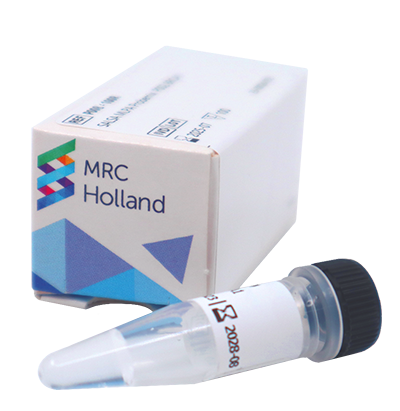
SALSA MLPA Probemix P178 F8 detects copy number variations in the F8 gene.
Contents: 43 MLPA probes, including 33 probes for F8 covering all 26 exons.
Tissue: genomic DNA isolated from human peripheral whole blood.
Application: hemophilia A (HA).
IVDR certified for in vitro diagnostic (IVD) use.
This product has recently been CE-marked for in vitro diagnostic (IVD) use under the In Vitro Diagnostic Regulation (IVDR; EU 2017/746), which replaces the former CE-marking under the IVD Directive (IVDD; Directive 98/79/EC). This update was accompanied by a change in format of the product description. Some information can now be found in a different location (more information).
The SALSA MLPA Probemix P178 F8 is an in vitro diagnostic (IVD) or research use only (RUO) semi-quantitative manual assay for the detection of deletions or duplications in the F8 gene in genomic DNA isolated from human peripheral whole blood specimens. P178 F8 is intended to confirm a potential cause for and clinical diagnosis of hemophilia A, and for molecular genetic testing of at-risk family members.
For the full intended purpose, see the product description.
Hemophilia A, one of the most common coagulation disorders, is caused by complete or partial deficiency in factor VIII (FVIII) clotting activity. Depending on the remaining level of FVIII clotting activity, three types of hemophilia A can be discriminated: (1) severe hemophilia A with <1% FVIII activity, (2) moderate hemophilia A with 1-5% FVIII activity, and (3) mild hemophilia A with 5-40% FVIII activity (GeneReviews). FVIII functions as a pro-coagulation cofactor and without it, the body is unable to form a stable clot at the site of an injury (Moghadam et al. 2024). Thus, the hallmark of hemophilia is the tendency to bleed (Grigore et al. 2024, Srivastava et al. 2020). Even minor injuries can trigger significant bleeding (Ray et al. 2024).
Hemophilia A is an X-linked recessive disease with a prevalence of approximately 1 in 4,000 live male births that is caused by mutations in the F8 gene encoding FVIII (GeneReviews; Bernardo et al. 2022, Grigore et al. 2024, Letelier et al. 2022, Moghadam et al. 2024). Pathogenic variants causative of hemophilia A span the entire mutation spectrum, i.e. missense mutations, small deletions or insertions, nonsense mutations, splice site mutations, deletions and duplications, and intron inversions (GeneReviews). Specifically, point mutations explain 43-51% of severe hemophilia A cases and 76-99% of moderate or mild hemophilia A cases, and F8 intron 1 and intron 22 inversions account for approximately 2-5% and 43-45% of severe hemophilia A cases, respectively. Presently, F8 intron 1 and intron 22 inversions are not linked to moderate or mild hemophilia A (GeneReviews). Large deletions and duplications account for approximately 5-10% of F8 gene defects causative of disease (https://dbs.eahad.org/FVIII; https://www.cdc.gov/hemophilia/mutation-project/index.html; Guo et al. 2018, Lannoy and Hermans 2022, Li et al. 2023, Pezeshkpoor et al. 2022).
Hemophilia A occurs in females due to different genetic mechanisms. These include heterozygosity for an F8 pathogenic variant associated with skewed inactivation of the normal X-chromosome, homozygosity or compound heterozygosity for two F8 pathogenic variants, or X chromosome abnormalities such as Turner syndrome (Garagiola et al. 2021; Janczar et al. 2020; Shen et al. 2022).
SALSA MLPA Probemix P178 F8 is CE-marked under the IVDR for in vitro diagnostic (IVD) use in Europe.
This assay is for research use only (RUO) in all other territories.
Translations of the product description in selected European languages are available upon request. Please contact us or one of our local sales partners. Translations of the MLPA General Protocol in selected languages are available here.
The Summary of Safety and Performance (SSP) is also available upon request.
A general SALSA MLPA Reagent Kit is required for MLPA experiments (to be ordered separately).
The prices above are list prices for direct orders from MRC Holland. Contact us for a quote that takes discounts and additional costs (such as shipping costs) into account. Different prices apply for orders through one of our sales partners; contact your local supplier for a quote.
Inclusion of a positive sample is usually not required, but can be useful for the analysis of your experiments. MRC Holland has very limited access to positive samples and cannot supply such samples. We recommend using positive samples from your own collection. Alternatively, you can use positive samples from an online biorepository, such as the Coriell Institute.
The commercially available positive samples below can be used with the current (B4) version of this product.