Choose your country to see the products for your location

P163 GJB-WFS1-POU3F4
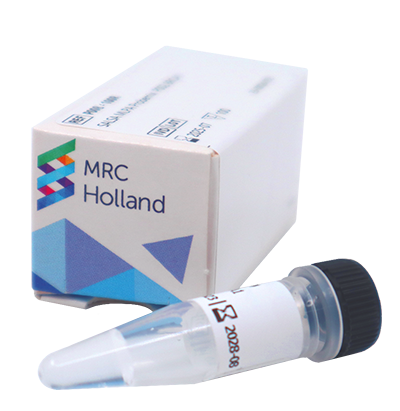
SALSA MLPA Probemix P163 GJB-WFS1-POU3F4 detects copy number variations in the GJB2, GJB3, GJB6, WFS1 and POU3F4 genes, and microdeletions in the upstream region of POU3F4.

Specifications

Contents: 51 MLPA probes, including 3 probes for GJB2, 5 probes for GJB6, 4 probes for GJB3, 9 probes for the POU3F4 region, 9 probes for WFS1 and 6 probes for the c.313del14, c.235delC, c.167delT, c.101T>C, c.35delG and IVS1+1G>A mutations in GJB2.

Tissue: genomic DNA isolated from human peripheral whole blood.

Application: hereditary hearing loss, and Wolfram syndrome type 1 (WFS1).

IVDR certified for in vitro diagnostic (IVD) use. Not all targets are for IVD use.
MRC Holland has recently obtained the In Vitro Diagnostic Regulation (IVDR; EU 2017/746) certification for this product. The CE-IVDR version will be sold latest Q2 of 2026, and will be accompanied by changes in the intended purpose. The probes targeting GJB3 will no longer be intended for diagnostic use. The probes targeting GJB2, GJB6, WFS1, and POU3F4 will be limited to the detection of deletions. This product will no longer be intended for clinical diagnosis of hereditary hearing loss, but can still be used to confirm a potential cause for this condition. The composition of this product remains unchanged.

Intended purpose

The SALSA MLPA Probemix P163 GJB-WFS1-POU3F4 is an in vitro diagnostic (IVD) or research use only (RUO) semi-quantitative manual assay for the detection of deletions in the GJB2, GJB6, WFS1, and POU3F4 genes, microdeletions upstream of POU3F4, and the wildtype sequence of six specific mutations in the GJB2 gene in genomic DNA isolated from human peripheral whole blood specimens. P163 GJB-WFS1-POU3F4 is intended to confirm a potential cause for hereditary hearing loss, and to confirm a potential cause for and clinical diagnosis of Wolfram syndrome type 1. This assay can also be used for molecular genetic testing of at-risk family members.

Certain probes targeting additional genes included in P163 GJB-WFS1-POU3F4 may only be used in a research setting. The following table summarises which probes are for IVD, and which are exclusively restricted to RUO use.

IVD targets
RUO targets
CNVs: GJB2, GJB6, WFS1, POU3F4
CNVs: GJB3

For the full intended purpose, see the product description.

Clinical background

Hearing loss is a common congenital defect and is defined as a sensorineural loss of 35 dB or more. The estimated incidence of permanent hearing loss at birth is one in 500 newborns. The origins of hearing loss may be genetic, environmental or multifactorial, with at least 50% of prelingual hearing loss in industrialised countries attributable to genetic abnormalities (GeneReviews). More than 70% of hereditary hearing loss is non-syndromic; the remaining 30% is accompanied by additional clinical findings and is therefore considered syndromic.

In many populations, up to 50% of all cases of autosomal recessive non-syndromic hearing loss are caused by mutations in the DFNB1 (Deafness, Non-syndromic, autosomal recessive 1) locus on 13q12 (GeneReviews). This locus contains the GJB2 and GJB6 genes, encoding connexin 26 and 30 proteins, respectively. The majority of individuals (99%) with DFNB1 are either homozygous or compound heterozygous for GJB2 pathogenic SNV variants. The remaining 1% are compound heterozygous for one GJB2 pathogenic SNV variant and a deletion in the GJB2 gene or one of three large deletions that includes sequences upstream of GJB2, such as CRYL1 and a portion of GJB6. The vast majority of pathogenic variants in GJB2 are SNVs or indels. While the frequency of mutations in GJB2 vary significantly across populations, commonly occurring mutations include c.35delG, c.101T>C, c.167delT, c.235delC, c.-23+1G>A (IVS1+1G>A), and 313del14. Large deletions account for less than 1% of pathogenic variants in GJB2. Two large deletions upstream of the GJB2 gene, del(GJB6-D13S1830) and del(GJB6-D13S1854) in the GJB6 gene, are the most common GJB6 mutations in hereditary hearing loss patients, and most often co-occur with mutations in GJB2 (del Castillo et al. 2005; del Castillo et al. 2003).

It is estimated that roughly 1% of hereditary hearing loss is caused by genes on the X-chromosome and, of these, 50% are caused by mutations in the POU3F4 gene or its upstream regulatory elements, known as X-linked non-syndromic hearing impairment (DFNX2 or DFN3). The POU3F4 gene is located on the X chromosome in a 3 Mb gene desert region enriched for highly conserved non-coding regions. Mutations in this region are most commonly SNVs and indels, but large deletions have also been reported (Feng et al. 2024, Vore et al. 2005, Song et al. 2010).

Wolfram syndrome type 1 (WFS1) is a progressive neurodegenerative disorder characterised by the onset of diabetes mellitus and optic atrophy before the age of 15 and is typically associated with sensorineural hearing loss, progressive neurologic abnormalities, and other endocrine abnormalities (GeneReviews). WFS1 is caused by mutations of WFS1 gene, which encodes the wolframin protein. This is a very rare form of hereditary hearing loss and exists on a spectrum, with clinical severity often reflecting the underlying genetic variant. The majority (>95%) of pathogenic variants in the WFS1 gene are SNVs or indels, though large deletions in WFS1 have also been reported (Resmerita et al. 2020, Riza et al. 2022).

Regulatory status

SALSA MLPA Probemix P163 GJB-WFS1-POU3F4 is CE-marked under the IVDR for in vitro diagnostic (IVD) use in Europe.

This assay is for research use only (RUO) in all other territories.

Product documentation

Translations and Summary of Safety and Performance

Translations of the product description in selected European languages are available upon request. Please contact us or one of our local sales partners. Translations of the MLPA General Protocol in selected languages are available here.

The Summary of Safety and Performance (SSP) is also available upon request.

List prices

Product

Item no.
Description
Technology
Price
P163-025R
SALSA MLPA Probemix P163 GJB-WFS1-POU3F4 – 25 rxn
€ 296.00
P163-050R
SALSA MLPA Probemix P163 GJB-WFS1-POU3F4 – 50 rxn
€ 580.00
P163-100R
SALSA MLPA Probemix P163 GJB-WFS1-POU3F4 – 100 rxn
€ 1135.00

Required reagents

A general SALSA MLPA Reagent Kit is required for MLPA experiments (to be ordered separately).

Item no.
Description
Technology
Price
EK1-FAM
SALSA MLPA Reagent Kit – 100 rxn – FAM (6 vials)
€ 361.00
EK1-CY5
SALSA MLPA Reagent Kit – 100 rxn – Cy5 (6 vials)
€ 361.00
EK5-FAM
SALSA MLPA Reagent Kit – 500 rxn – FAM (5×6 vials)
€ 1658.00
EK5-CY5
SALSA MLPA Reagent Kit – 500 rxn – Cy5 (5×6 vials)
€ 1658.00
EK20-FAM
SALSA MLPA Reagent Kit – 2000 rxn – FAM (5×6 vials)
€ 6373.00

Price details & ordering

The prices above are list prices for direct orders from MRC Holland. Contact us for a quote that takes discounts and additional costs (such as shipping costs) into account. Different prices apply for orders through one of our sales partners; contact your local supplier for a quote.

Positive samples

Inclusion of a positive sample is usually not required, but can be useful for the analysis of your experiments. MRC Holland has very limited access to positive samples and cannot supply such samples. We recommend using positive samples from your own collection. Alternatively, you can use positive samples from an online biorepository, such as the Coriell Institute.

The commercially available positive samples below can be used with the current (E1) version of this product.

  • Coriell HG00478 (m): Heterozygous positive for the GJB2 c.235delC mutation.
  • Coriell NA12606 (m): Large heterozygous duplication (42 Mb) affecting the probes for GJB2, GJB6, CRYL1 and flanking probes.
  • Coriell NA22601 (m): Heterozygous deletion affecting the probes for WFS1.
  • Coriell NA23835 (m): Heterozygous positive for the GJB2 35delG and the 101T>C mutations.

Publications

Selected publications using P163 GJB-WFS1-POU3F4

  • Arunachalam RK et al. (2020). Mutation Analysis Using Multiplex Ligation-Dependent Probe Amplification in Consanguineous Families in South India with a Child with Profound Hearing Impairment. Lab Med. 51:56-65.
  • Da Silva-Costa SM et al. (2009). Screening for the GJB2 c.-3170 G>A (IVS 1+1 G>A) mutation in Brazilian deaf individuals using multiplex ligation-dependent probe amplification. Genet Test Mol Biomarkers. 13:701-4.
  • Da Silva-Costa SM et al. (2011). Searching for digenic inheritance in deaf Brazilian individuals using the multiplex ligation-dependent probe amplification technique. Genet Test Mol Biomarkers. 15:849-53.
  • Küçük Kurtulgan H et al. (2019). The Analysis of GJB2, GJB3, and GJB6 Gene Mutations in Patients with Hereditary Non-Syndromic Hearing Loss Living in Sivas. J Int Adv Otol. 15:373-8.
  • Özyilmaz B et al. (2019). First-Line Molecular Genetic Evaluation of Autosomal Recessive Non-Syndromic Hearing Loss. Turk Arch Otorhinolaryngol. 57:140-8.
  • Petrova N et al. (2023). Hereditary etiology of non-syndromic sensorineural hearing loss in the Republic of North Ossetia-Alania. PeerJ. 11:e14514.
  • Prochazkova D et al. (2016). A p.(Glu809Lys) Mutation in the WFS1 Gene Associated with Wolfram-like Syndrome: A Case Report. J Clin Res Pediatr Endocrinol. 8:482-3.
  • Resmerita I et al. (2020). Genetics of Hearing Impairment in North-Eastern Romania-A Cost-Effective Improved Diagnosis and Literature Review. Genes (Basel). 11:1506.
  • Sansovic I et al. (2009). GJB2 mutations in patients with nonsyndromic hearing loss from Croatia. Genet Test Mol Biomarkers. 13:693-9.
  • Smeds H et al. (2022). X-linked Malformation Deafness: Neurodevelopmental Symptoms Are Common in Children With IP3 Malformation and Mutation in POU3F4. Ear Hear. 43:53-69.

References

  • Naranjo S et al. (2010). Multiple enhancers located in a 1-Mb region upstream of POU3F4 promote expression during inner ear development and may be required for hearing. Hum Genet. 128:411-9.
  • Song MH et al. (2010). Clinical evaluation of DFN3 patients with deletions in the POU3F4 locus and detection of carrier female using MLPA. Clin Genet. 78:524-32.
  • Vore AP et al. (2005). Deletion of and novel missense mutation in POU3F4 in 2 families segregating X-linked nonsyndromic deafness. Arch Otolaryngol Head Neck Surg. 131:1057-63.

Sign in

Don't have an account? Create one

Forgot password?

Select Your Country

Choose your country to see the products for your location

CE

CE-marked products are for In Vitro Diagnostic (IVD) use only in EU (candidate) member states and members of the European Free Trade Association (EFTA), and the UK.

CE2797

CE-marked products are for In Vitro Diagnostic (IVD) use only in EU (candidate) member states and members of the European Free Trade Association (EFTA), and the UK.