Choose your country to see the products for your location

P520 MPN mix 2

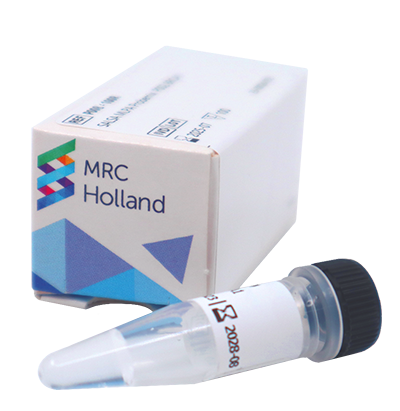
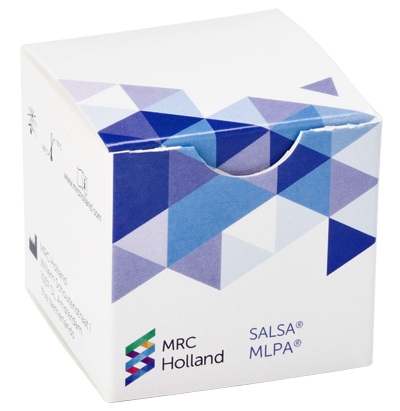
SALSA MLPA Probemix P520 MPN mix 1 detects mutations frequently found in myeloproliferative neoplasms in the JAK2, MPL, CALR and KIT genes.

Specifications

Contents: 25 MLPA probes, including probes for JAK2 c.1849G>T (p.V617F), JAK2 c.1627_1632delGAAGAT (p.E543_D544del), JAK2 c.1624_1629delAATGAA (p.N542_E543del), MPL c.1544G>T (p.W515L), MPL c.1543_1544TG>AA (p.W515K), KIT c.2447A>T (p.D816V), CALR c.1092_1143del52 (p.L367fs*46), and CALR c.1154_1155insTTGTC (p.K385fs*47).

Tissue: human genomic DNA.

Application: research on myeloproliferative neoplasms (MPNs), including polycythemia vera (PV), essential thrombocythemia (ET), primary myelofibrosis (PMF), and systemic mastocytosis (SM).

For research use only (RUO). Not for use in diagnostics.
P520 MPN mix 2 can detect allelic burdens of the targeted mutations as low as 1%, but can generate saturated signals with allelic burdens above 10%. To test samples with higher allelic burdens, see P420 MPN mix 1.

General information

The SALSA MLPA Probemix P520 MPN mix 2 is a research use only (RUO) assay for detection of eight different mutations frequently found in MPNs in JAK2, MPL, CALR and KIT genes.

MPNs are clonal hematopoietic stem cell malignancies, characterized by excessive production of blood cells. MPNs are subdivided in polycytemia vera (PV), essential thrombocytemia (ET), primary myelofibrosis (PMF) and less common conditions like chronic neutrophilic leukemia (CNL), chronic eosinophilic leukemia (CEL), hypereosinophilic syndrome (HES) and mastocytosis.

Discovery of a frequent JAK2 mutation (9p24.1), common to classic MPNs (PV, ET and PMF), has linked these diseases on a molecular level. The current WHO diagnostic criteria for classic MPNs include presence of JAK2, CALR or MPL mutations. The JAK2 p.V617F point mutation is detected in ~98% of PV patients, and in ~60% of patients with ET and PMF, whereas other JAK2 exon 12 mutations are commonly found in p.V617F negative PV patients. P520-A2 MPN mix 2 contains three mutation-specific JAK2 probes: one probe for p.V617F and two probes for the most common exon 12 mutations p.N542_E543del and p.E543_D544del.

Mutations in the MPL gene (1p34.2) are found in 4-11% of JAK2 p.V617F negative ET and PMF patients. This problemix contains two mutation-specific probes for MPL, p.W515K and p.W515L, that are diagnostically relevant in PV, ET and PMF according to the WHO classification.

The discovery of novel CALR gene (19p13.13) mutations in ET and PMF provides additional diagnostic tools for MPNs. Patients with ET and PMF but negative for JAK2 and MPL mutations, have been reported to harbour somatic insertions and deletions in exon 9 of the CALR gene. A 52-bp deletion (type 1) and a 5-bp insertion (type 2) are the most common mutations found in the CALR gene (53% and 32%, respectively). These mutations result in a frameshift to an alternative reading frame (Klampfl et al. 2013, Nangalia et al. 2013). CALR mutation-specific probes for the 52-bp deletion (p.L367fs*46, type 1) and 5-bp insertion (p.K385fs*47, type 2) are included in this probemix.

In addition, a probe specific for the D816V mutation in the KIT gene (4q12) is present. This is the most common KIT mutation and is present in >90% of patients with systemic mastocytosis (SM). Consequently, the presence of this mutation is considered a diagnostic criterion of SM according to the WHO classification.

Regulatory status

SALSA MLPA Probemix P520 MPN mix 2 is for research use only (RUO) in all territories.

SALSA Sample DNA for this product

SALSA Threshold & Binning DNA SD057 is an artificial DNA sample with a signal for all probes in the P520 MPN mix 2 probemix. Inclusion of a reaction with SD057 in initial experiments and in experiments following a change in electrophoresis conditions is recommended to aid in the creation of a bin set that links peaks to the probes that produce them. SD057 can also be used as a mutation calling threshold sample, as it contains an estimated 1% allelic burden of the mutations detected by this probemix. Inclusion of one reaction with 5 μl SD057 (20 ng/μl) Threshold & Binning DNA with total of 100 ng of DNA in each MLPA experiment is, therefore, essential. For reliable threshold determination and subsequently mutation calling, it is highly recommended to include three reactions of SD057 in each MLPA experiment.

A vial of SD057 is included with every order of the P520 MPN mix 2 probemix, but it is possible to order additional vials separately.

For more information, see the product description.

List prices

Product

Item no.
Description
Technology
Price
P520-025R
SALSA MLPA Probemix P520 MPN mix 2 – 25 rxn
€ 296.00
P520-050R
SALSA MLPA Probemix P520 MPN mix 2 – 50 rxn
€ 580.00
P520-100R
SALSA MLPA Probemix P520 MPN mix 2 – 100 rxn
€ 1135.00

Required reagents

A general SALSA MLPA Reagent Kit is required for MLPA experiments (to be ordered separately).

Item no.
Description
Technology
Price
EK1-FAM
SALSA MLPA Reagent Kit – 100 rxn – FAM (6 vials)
€ 361.00
EK1-CY5
SALSA MLPA Reagent Kit – 100 rxn – Cy5 (6 vials)
€ 361.00
EK5-FAM
SALSA MLPA Reagent Kit – 500 rxn – FAM (5×6 vials)
€ 1658.00
EK5-CY5
SALSA MLPA Reagent Kit – 500 rxn – Cy5 (5×6 vials)
€ 1658.00
EK20-FAM
SALSA MLPA Reagent Kit – 2000 rxn – FAM (5×6 vials)
€ 6373.00

Sample DNAs (included)

A vial is included with every order of this probemix, but additional vials can also be purchased separately.

Item no.
Description
Technology
Price
SD057
€ 62.00

Price details & ordering

The prices above are list prices for direct orders from MRC Holland. Contact us for a quote that takes discounts and additional costs (such as shipping costs) into account. Different prices apply for orders through one of our sales partners; contact your local supplier for a quote.

Positive samples

Inclusion of a positive sample is usually not required, but can be useful for the analysis of your experiments. MRC Holland has very limited access to positive samples and cannot supply such samples. We recommend using positive samples from your own collection. Alternatively, you can use positive samples from an online biorepository, such as the Coriell Institute.

See this support article for commercially available positive samples that can be used with this product.

Sign in

Don't have an account? Create one

Forgot password?

Select Your Country

Choose your country to see the products for your location