Choose your country to see the products for your location

P008 PMS2

SALSA MLPA Probemix P008 PMS2 detects copy number variations in the PMS2 gene and/or its pseudogene PMS2CL.

Specifications

Contents: 47 MLPA probes, including 34 probes for PMS2 and/or its pseudogene PMS2CL: 19 PMS2-specific probes for exons 1 – 11, 5 probes for exons 12 – 15 of PMS2 and the homologous region in PMS2CL, and 10 SNV probes (5 SNV probe pairs) for allelic variants located in the exon 11 – 15 region of PMS2 or the homologous region in PMS2CL.

Tissue: genomic DNA isolated from human peripheral whole blood.

Application: Lynch syndrome (LS), and constitutional mismatch repair deficiency (CMMRD) syndrome.

IVDR certified and registered for in vitro diagnostic (IVD) use in selected territories.
This product has recently been CE-marked for in vitro diagnostic (IVD) use under the In Vitro Diagnostic Regulation (IVDR; EU 2017/746), which replaces the former CE-marking under the IVD Directive (IVDD; Directive 98/79/EC). This update was accompanied by a change in the intended purpose and a change in format of the product description. Some information can now be found in a different location (more information).

Intended purpose

The SALSA MLPA Probemix P008 PMS2 is an in vitro diagnostic (IVD) or research use only (RUO) semi-quantitative manual assay for the detection of deletions or duplications in the PMS2 gene in genomic DNA isolated from human peripheral whole blood specimens. P008 PMS2 is intended to confirm a potential cause for and clinical diagnosis of Lynch syndrome (deletions or duplications in PMS2, in the context of a monoallelic variant) or constitutional mismatch repair deficiency syndrome (deletions in PMS2, in the context of biallelic pathogenic variants) and for molecular genetic testing of at-risk family members.

For the full intended purpose, see the product description.

Clinical background

Lynch syndrome (LS)

Lynch syndrome (LS), formerly known as hereditary non-polyposis colorectal cancer (HNPCC), is an inherited disorder characterized by an increased predisposition to several cancer types. It is an autosomal dominantly inherited syndrome with gene-dependent, age-related penetrance. Prevalence of LS in the general population has been estimated at 1:279 (Evans et al. 2021, Kunnackal John et al. 2021). LS accounts for 2-3% of all colorectal cancer (CRC) cases, 3% of endometrial cancer (EC) cases and <1% of ovarian cancers. Muir-Torre syndrome (MTS), which is considered a clinical variant of LS, is characterized by synchronous or metachronous occurrence of cutaneous tumours, associated with at least one LS-related internal cancer.

LS is caused by heterozygous germline mutations in one of the four major DNA mismatch repair (MMR) genes, i.e. MLH1, MSH2, MSH6 or PMS2. Another cause of LS is deletion of the 3' part of EPCAM, leading to constitutional epigenetic silencing of the downstream MSH2 gene (Lynch et al. 2015). The estimated contribution of the different genes to LS is 15-40% for MLH1, 20-40% for MSH2, 12-35% for MSH6, 5-25% for PMS2, and <10% for EPCAM (GeneReviews). It is estimated that 20-55% of the pathogenic PMS2 mutations identified in LS are attributed to large deletions or duplications encompassing one or more exons. Point mutations and small indels constitute 45-80% of the pathogenic PMS2 mutations (GeneReviews). Tumors exhibit MMR deficiency, which is the consequence of somatic inactivation of the wild-type allele of the affected gene and leads to microsatellite instability (MSI) in the tumor cell DNA, which is the molecular hallmark of the disease.

Constitutional mismatch repair deficiency syndrome

Constitutional mismatch repair deficiency syndrome (CMMRD) is a rare inherited childhood cancer syndrome characterized by early-onset colorectal cancers, hematological malignancies, and brain tumors. These malignancies are often associated with features of neurofibromatosis type 1 (NF1), such as café-au-lait macules (Wimmer and Etzler 2008). CMMRD is a highly penetrant, lethal syndrome with almost 100% mortality by age 35. The syndrome affects 1 in 1,000,000 newborns. CMMRD syndrome is caused by bi-allelic, i.e. homozygous or compound heterozygous, germline mutations in MLH1, MSH2, MSH6 or PMS2 (Wimmer and Etzler 2008). Mutations in PMS2 are the most common cause of this recessive condition and are responsible for ~50-60% of the CMMRD cases reported thus far (Herkert et al. 2011, Wimmer et al. 2014). Overall, the percentage of CMMRD syndrome cases caused by large deletions in PMS2 is ~12% (Bodo et al. 2015, Herkert et al. 2011). Whereas MMR deficiency is only seen in tumor cells in LS patients, it is seen in all cells of CMMRD syndrome patients.

PMS2 and PMS2CL

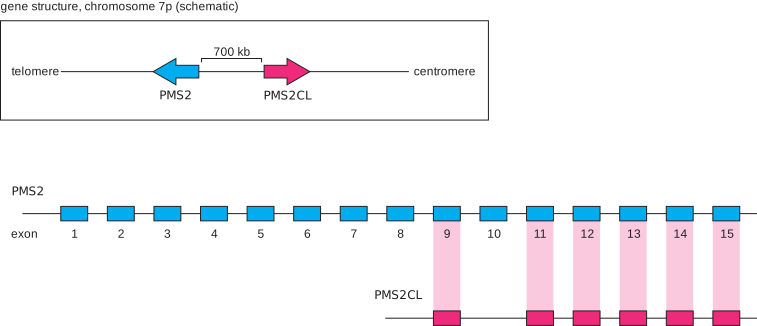
The PMS2 gene spans 36 kilobases on chromosome 7p22.1 and contains 15 exons (Figure 1). Mutation analysis of the PMS2 gene is complicated by the presence of at least 15 highly homologous non-functional pseudogenes. There are several known pseudogenes present on the long arm of chromosome 7 that have exons 1 to 5 in various organisations, and one highly homologous pseudogene (PMS2CL) which lies in an inverted 100 kb segmental duplication located ~700 kb centromeric of PMS2 (De Vos et al. 2004). PMS2CL contains a copy of the 3' end of PMS2, more specifically of exons 9 and 11-15. A region of 2.7 kb encompassing PMS2 exon 10 is absent in PMS2CL. No reliable sequence differences exist between PMS2 exons 12-15 and the associated exons in PMS2CL (van der Klift et al. 2010). As a consequence, many techniques used for copy number determination, including MLPA with P008 PMS2, cannot discriminate between exons 12-15 of PMS2 and the associated exons in PMS2CL. In P008 PMS2, only the detection of the combined copy number of the two gene regions is possible, i.e. four copies in healthy individuals. When a copy number change is observed in the PMS2 exons 12-15 region, it can be present in either PMS2 or PMS2CL. Therefore, follow-up studies are needed to determine which of the two genes is affected. Only copy number changes of PMS2 are linked to LS and CMMRD syndrome. No medical consequences stemming from copy number changes of the non-functional PMS2CL pseudogene have been reported to date.

Figure 1. Schematic representation of the exons of PMS2 and homologous exons in PMS2CL
Figure 1. Schematic representation of the exons of PMS2 and homologous exons in PMS2CL.

Webinar: Why is MLPA the preferred method for detecting PMS2 CNVs in Lynch syndrome?

For more information pertaining to the clinical background of LS, CMMRD syndrome, and the particularities of the PMS2 gene, please consult the first part of the SALSA MLPA Probemix P008 PMS2 product focus webinar series: Part 1: Why is MLPA the preferred method for detecting PMS2 CNVs in Lynch syndrome?

Please note: this webinar is the first part in a three-part series.

Result interpretation

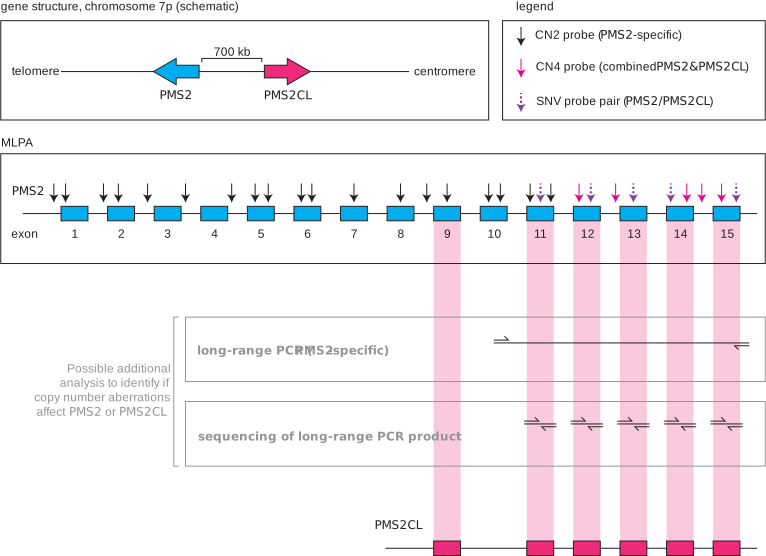
Due to the presence of the highly similar PMS2CL pseudogene, differentiating CNVs in PMS2 and PMS2CL is not always possible. However, to obtain as much information about the PMS2 region as possible using the MLPA technique, three different probe types with specific purposes are included in P008 PMS2:

  • PMS2-specific probes that target 2 copies in healthy individuals.
  • Combined PMS2&PMS2CL probes that target 4 copies in healthy individuals.
  • PMS2/PMS2CL SNV probe pairs that target both allelic forms of five SNVs present in either exons 11-15 of PMS2 or in the homologous exons of PMS2CL.

PMS2-specific probes

The PMS2-specific probes specifically target exons 1-11 of the PMS2 gene. Although PMS2 exons 9 and 11 have a high homology with associated exons in PMS2CL, the PMS2-specific probes have been designed to detect sequences that are only present in the PMS2 gene. Therefore, the final ratios (FRs) obtained from these probes are directly indicative of the copy number of exons 1-11 of the PMS2 gene.

Combined PMS2&PMS2CL probes

The combined probes for PMS2 and PMS2CL target exons 12-15 of the PMS2 gene as well as the homologous exons in the PMS2CL pseudogene. The very high homology between these regions prevents the design of probes that are unique for one target sequence. Consequently, the final ratios obtained from the combined PMS2 & PMS2CL probes provide information on the combined copy number status of both PMS2 and PMS2CL.

PMS2/PMS2CL SNV probe pairs

The PMS2/PMS2CL SNV probe pairs target both allelic forms of five SNVs present in either exons 11-15 of PMS2 or in the associated exons of PMS2CL. The distribution of these SNVs among PMS2 and PMS2CL varies. Therefore, the FR obtained from each of these probes correlates to the total number of PMS2 and PMS2CL copies presenting the SNV allele. In individuals without CNVs, the sum of the total number of copies resulting from both allele probes of a probe pair is expected to be 4 (2 alleles in PMS2 and 2 alleles in PMS2CL). This is valid for each probe pair.

Combining information from all probe types

To interpret the results obtained with P008 PMS2, it is recommended to combine information from all three probe types described above.

If an aberration is detected using the PMS2-specific probes, information from the combined PMS2&PMS2CL probes and the PMS2/PMS2CL SNV probe pairs can be used to determine the extent of the copy number change. Note that care should be taken if only the exon 11 PMS2-specific probe indicates an aberration, as gene conversion may occur between PMS2 and PMS2CL in this region.

If an aberration is detected only by non-PMS2-specific probes, MLPA alone cannot determine whether the copy number change is present in PMS2 or PMS2CL. Gene-specific long-range PCR and (next generation) sequencing analysis can help determine whether the copy number change is present in the gene or the pseudogene (Li et al. 2015, Vaughn et al. 2011) (Figure 2).

Importantly, allocation of the copy number change to either PMS2 or PMS2CL will not be possible when all alleles of PMS2 and PMS2CL share the same variants targeted by the SNV-specific probes. In situations like these, family studies may aid in determining whether the copy number change is present in PMS2 or PMS2CL.

Figure 2. Schematic representation of the use of long-range PCR and sequencing to further elucidate P008 PMS2 results
Figure 2. Schematic representation of the use of long-range PCR and sequencing to further elucidate P008 PMS2 results.

Please note that there are other methods to investigate whether CNVs are present in PMS2 or PMS2CL, such as capture-NGS. Furthermore, it is important to note that gene conversions are known to occur between PMS2 and PMS2CL, which may involve additional exons and thereby complicate result interpretation.

Webinar: How to interpret results obtained with P008 to detect PMS2 CNVs in Lynch syndrome?

For more information on the use of other techniques to discriminate between PMS2 and PMS2CL, please consult the second part of the SALSA MLPA Probemix P008 PMS2 product focus webinar series: Part 2: How to interpret results obtained with P008 to detect PMS2 CNVs in Lynch syndrome?

Please note: this webinar is the second part in a three-part series.

Reference sample selection

For correct data analysis using P008 PMS2, it is critical to include suitable reference samples in each experiment. Suitable reference samples have two copies for each allele detected by the ten SNV probe pairs. MRC Holland has selected a cell line with two copies for each of the allelic variants, Reference Selection DNA SD082, which should be used for the initial selection of suitable reference samples from your own collection. Reference Selection DNA SD082 should never be used as a reference sample. In our experience, approximately one in four tested DNA samples from healthy individuals is suitable as a reference sample. By testing 20 different DNA samples from healthy individuals with P008 PMS2, and including three reactions with Reference Selection DNA SD082, there is a good chance of finding at least three different suitable reference samples. Suitable reference samples provide results aligning with the Reference Selection DNA SD082 for each probe, including the ten SNV-specific probes.

Webinar: How to select reference samples with Reference Selection DNA SD082?

For more information about the use of Reference Selection DNA SD082 for suitable reference sample selection, please consult the third part of the SALSA MLPA Probemix P008 PMS2 product focus webinar series: Part 3: How to select reference samples with Reference Selection DNA SD082?

Please note: this webinar is the third part in a three-part series.

Importantly, the instructions from this part of the webinar must be followed in order to find suitable reference samples for your own experiments. Note that test and reference samples must always be treated as similarly as possible (e.g. extraction method, tissue type, DNA concentration, sample treatment).

Regulatory status

SALSA MLPA Probemix P008 PMS2 is CE-marked under the IVDR for in vitro diagnostic (IVD) use in Europe. This assay is also registered for IVD use in Colombia and Israel.

This assay is for research use only (RUO) in all other territories.

SALSA Sample DNA for this product

SALSA Reference Selection DNA SD082 can be used to aid in the selection of suitable reference samples for the P008 PMS2 probemix. Reference Selection DNA can only be used in initial experiments on DNA samples from healthy individuals from your sample collection with the intention to identify suitable reference samples. SD082 cannot be used as a reference sample in subsequent experiments.

A vial of SALSA Reference Selection DNA SD082 is included with every order of the P008 PMS2 probemix, but it is possible to order additional vials separately.

For more information, see reference sample selection.

Product documentation

Translations and Summary of Safety and Performance

Translations of the product description in selected European languages are available upon request. Please contact us or one of our local sales partners. Translations of the MLPA General Protocol in selected languages are available here.

The Summary of Safety and Performance (SSP) is also available upon request.

List prices

Product

Item no.
Description
Technology
Price
P008-025R
SALSA MLPA Probemix P008 PMS2 – 25 rxn
€ 296.00
P008-050R
SALSA MLPA Probemix P008 PMS2 – 50 rxn
€ 580.00
P008-100R
SALSA MLPA Probemix P008 PMS2 – 100 rxn
€ 1135.00

Required reagents

A general SALSA MLPA Reagent Kit is required for MLPA experiments (to be ordered separately).

Item no.
Description
Technology
Price
EK1-FAM
SALSA MLPA Reagent Kit – 100 rxn – FAM (6 vials)
€ 361.00
EK1-CY5
SALSA MLPA Reagent Kit – 100 rxn – Cy5 (6 vials)
€ 361.00
EK5-FAM
SALSA MLPA Reagent Kit – 500 rxn – FAM (5×6 vials)
€ 1658.00
EK5-CY5
SALSA MLPA Reagent Kit – 500 rxn – Cy5 (5×6 vials)
€ 1658.00
EK20-FAM
SALSA MLPA Reagent Kit – 2000 rxn – FAM (5×6 vials)
€ 6373.00

Sample DNAs (included)

A vial is included with every order of this probemix, but additional vials can also be purchased separately.

Item no.
Description
Technology
Price
SD082
€ 25.00

Price details & ordering

The prices above are list prices for direct orders from MRC Holland. Contact us for a quote that takes discounts and additional costs (such as shipping costs) into account. Different prices apply for orders through one of our sales partners; contact your local supplier for a quote.

Positive samples

Inclusion of a positive sample is usually not required, but can be useful for the analysis of your experiments. MRC Holland has very limited access to positive samples and cannot supply such samples. We recommend using positive samples from your own collection. Alternatively, you can use positive samples from an online biorepository, such as the Coriell Institute.

We have no information about specific commercially available positive samples that can be used with this product.

Comparison of Lynch syndrome and polyposis syndrome products

MRC Holland offers various different assays for Lynch syndrome and polyposis syndrome. The table below indicates which product can be used for which target gene(s).

Currently Viewing Currently Viewing Currently Viewing Currently Viewing Currently Viewing Currently Viewing Currently Viewing Currently Viewing
P003 P248 2 P008 P072 ME011 P043 P378 D001/D002
Properties CE-marked yes yes yes yes yes yes yes no
Technique MLPA MLPA MLPA MLPA MS-MLPA MLPA MLPA digitalMLPA
Lynch syndrome (HNPCC) MLH1 3
MSH2 3
MSH6 3
PMS2 3
EPCAM 1
BRAF p.V600E
Polyposis syndrome FAP/AFAP: APC
MAP: MUTYH
Product page P003 P248 P008 P072 ME011 P043 P378 D001/D002
  1. P003 MLH1/MSH2 and ME011 Mismatch Repair Genes provide coverage of EPCAM exons 8 and 9. P072 MSH6-MUTYH, D001 Hereditary Cancer Panel 1 and D002 Hereditary Cancer Panel 2 cover these exons as well and provide extended coverage of the EPCAM region. Please consult the respective product descriptions for detailed information.
  2. P248 MLH1-MSH2 Confirmation is intended to confirm copy number variations in MLH1 and MSH2 detected with P003 MLH1/MSH2. Almost all MLH1 and MSH2 probes in P248 MLH1-MSH2 Confirmation have different ligation sites than those in P003 MLH1/MSH2. Due to the fact that the ligation sites of almost all MLH1 and MSH2 probes in P248 MLH1-MSH2 Confirmation are also different than those in D001 Hereditary Cancer Panel 1 and D002 Hereditary Cancer Panel 2, P248 MLH1-MSH2 Confirmation can additonally be used to confirm copy number variations in MLH1 and MSH2 detected with D001 and D002.
  3. These probes provide information on the copy number as well as methylation status of selected GCGC sites in the promoter region of the target genes.

Publications

Selected publications using P008 PMS2

  • Antelo M et al. (2015). Pitfalls in the diagnosis of biallelic PMS2 mutations. Fam Cancer. 14:411-4.
  • Borràs E et al. (2013). Refining the role of PMS2 in Lynch syndrome: germline mutational analysis improved by comprehensive assessment of variants. J Med Genet. 50:552-63.
  • Brea-Fernández AJ et al. (2014). High incidence of large deletions in the PMS2 gene in Spanish Lynch syndrome families. Clin Genet. 85:583-8.
  • Clendenning M et al. (2013). Detection of large scale 3' deletions in the PMS2 gene amongst Colon-CFR participants: have we been missing anything? Fam Cancer. 12:563-6.
  • Kerkhof J et al. (2017). Clinical Validation of Copy Number Variant Detection from Targeted Next-Generation Sequencing Panels. J Mol Diagn. 19:905-20.
  • Lagerstedt-Robinson K et al. (2016). Mismatch repair gene mutation spectrum in the Swedish Lynch syndrome population. Oncol Rep. 36:2823-35.
  • Rey JM et al. (2017). Improving Mutation Screening in Patients with Colorectal Cancer Predisposition Using Next-Generation Sequencing. J Mol Diagn. 19:589-601.
  • Sugano K et al. (2016). Germline PMS2 mutation screened by mismatch repair protein immunohistochemistry of colorectal cancer in Japan. Cancer Sci. 107:1677-86.
  • Vaughn CP et al. (2010). Clinical analysis of PMS2: mutation detection and avoidance of pseudogenes. Hum Mutat. 31:588-93.
  • Wernstedt A et al. (2012). Improved multiplex ligation-dependent probe amplification analysis identifies a deleterious PMS2 allele generated by recombination with crossover between PMS2 and PMS2CL. Genes Chromosomes Cancer. 51:819-31.

References

  • Bodo S et al. (2015). Diagnosis of Constitutional Mismatch Repair-Deficiency Syndrome Based on Microsatellite Instability and Lymphocyte Tolerance to Methylating Agents. Gastroenterology. 149:1017-29.e3.
  • De Vos M et al. (2004). Novel PMS2 pseudogenes can conceal recessive mutations causing a distinctive childhood cancer syndrome. Am J Hum Genet. 74:954-64.
  • Evans DG et al. (2022). Advances in genetic technologies result in improved diagnosis of mismatch repair deficiency in colorectal and endometrial cancers. J Med Genet. 59:328-34.
  • Herkert JC et al. (2011). Paediatric intestinal cancer and polyposis due to bi-allelic PMS2 mutations: case series, review and follow-up guidelines. Eur J Cancer. 47:965-82.
  • Kunnackal John G et al. (2021). Worldwide variation in lynch syndrome screening: case for universal screening in low colorectal cancer prevalence areas. Fam Cancer. 20:145-56.
  • Lynch HT et al. (2015). Milestones of Lynch syndrome: 1895-2015. Nat Rev Cancer. 15:181-94.
  • Van der Klift HM et al. (2010). Quantification of sequence exchange events between PMS2 and PMS2CL provides a basis for improved mutation scanning of Lynch syndrome patients. Hum Mutat. 31:578-87.
  • Wimmer K et al. (2008). Constitutional mismatch repair-deficiency syndrome: have we so far seen only the tip of an iceberg? Hum Genet. 124:105-22.
  • Wimmer K et al. (2014). Diagnostic criteria for constitutional mismatch repair deficiency syndrome: suggestions of the European consortium 'care for CMMRD' (C4CMMRD). J Med Genet. 51:355-65.

Sign in

Don't have an account? Create one

Forgot password?

Select Your Country

Choose your country to see the products for your location

CE

CE-marked products are for In Vitro Diagnostic (IVD) use only in EU (candidate) member states and members of the European Free Trade Association (EFTA), and the UK.

CE2797

CE-marked products are for In Vitro Diagnostic (IVD) use only in EU (candidate) member states and members of the European Free Trade Association (EFTA), and the UK.

CO

IVD-registered in Colombia.

IL

IVD-registered in Israel.