SALSA MLPA Probemix ME031 GNAS detects copy number variations and methylation status of the GNAS complex locus and copy number variations of the STX16 gene.
Contents: 53 MLPA probes, including 31 probes for the GNAS locus, of which 15 provide information on the methylation status, and 9 probes for STX16.
Tissue: human genomic DNA.
Application: research on genomic imprinting defect inactivating PTH/PTH-related protein signalling disorders subtype 3 (iPPSD3; also known as pseudohypoparathyroidism Ib or PHPIb), and iPPSD subtype 2 (iPPSD2).
For research use only (RUO). Not for use in diagnostics.
The SALSA MS-MLPA Probemix ME031 GNAS is a research use only (RUO) assay for the detection of aberrant methylation of one or more sequences of the GNAS complex locus. This probemix can also be used to detect deletions/duplications in the GNAS complex locus and the STX16 gene.
Genomic imprinting is the monoallelic expression of genes, dependent on the parental origin of the chromosome. It plays a role in growth and development. Imprinting disorders originate from a disturbance in this monoallelic expression by disruption or epimutation of imprinted genes (Ishida et al. 2013). Loss of methylation in the GNAS locus is associated with the genomic imprinting defect inactivating PTH/PTH-related protein signaling disorders subtype 3 (iPPSD3). Mutations in this locus are associated with iPPSD subtype 2 (iPPSD2) (Turan 2017).
iPPSD3, also referred to as pseudohypoparathyroidism Ib, is caused by loss of methylation (LOM) in the GNAS complex locus. iPPSD3 is characterised mainly by resistance to parathyroid hormone (PTH) and symptoms that include hypocalcemia, numbness, seizures, tetany, cataracts, and dental problems.
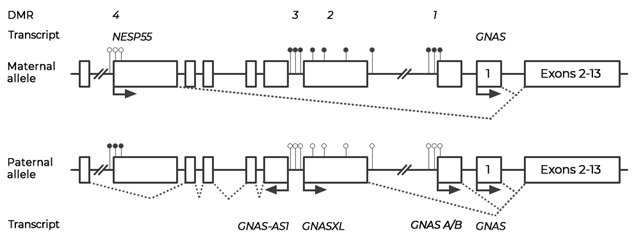
The GNAS locus is a complex imprinted locus on chromosome 20 that generates multiple transcripts through the use of several alternative first exons that splice into a common set of downstream exons (see Figure 1 in the product description). GNAS itself encodes the Gsα protein, which is the α-subunit in the heterotrimeric G protein. Due to differential methylation of their promoters, most gene products originate from one parental allele. Transcripts GNASXL, which encodes XLαs, GNAS A/B (also referred to as 1A) and the antisense transcript GNAS-AS1 (also referred to as NESPAS) are transcribed from the paternal allele, while NESP55 (also referred to as NESP or GNAS transcript variant 4) is transcribed from the maternal allele (Turan and Bastepe 2013). The most downstream promoter (GNAS exon 1) is not differentially methylated, which results in GNAS expression from both alleles in most tissues but its expression is silenced from the paternal allele in a small number of tissues (Turan and Bastepe 2013).
Figure 1. DMR 1, 2, 3 and 4 of GNAS locus. Exons are depicted as boxes. Dashed lines depict de exons that are spliced together to form the alternative transcripts. Arrows indicate the direction of transcription. The methylation status of the DMRs is indicated by filled in circles for methylated and empty circles for unmethylated regions. The numbered DMRs are as follows:
GNAS A/B transcription start site (GNAS A/B:TSS-DMR), covered by GNAS A/B exon 1 probes, maternally methylated.
GNASXL exon 1 (GNAS-XL:Ex1-DMR), covered by GNASXL exon 1 and intron 1 probes, maternally methylated.
GNAS-AS1 transcription start site (GNAS-AS1:TSS-DMR), covered by GNAS-AS1 exon 1 and upstream probes, maternally methylated.
NESP55 transcription start site (GNAS-NESP:TSS-DMR), covered by NESP55 exon 1 probes, paternally methylated.
Figure adapted from Lemos and Thakker (2015).
The Gsα and XLαs transcripts are involved in downstream signalling from parathyroid hormone (PTH), parathyroid hormone related protein (PTHrP) receptors and other hormone receptors like TSHR and GHRHR. The GNAS A/B transcript and the antisense transcript GNAS-AS1 are not translated into proteins, but are thought to influence Gsα expression via mechanisms that remain to be determined. The STX16 gene, lastly, is a long range control element of methylation at the GNAS locus, located more than 220 kb centromeric of GNAS (Turan and Bastepe 2013).
PHPIb is caused by loss-of-methylation (LOM) at GNAS A/B located within DMR 1 in the GNAS complex locus (Figure 1 in the product description). LOM can also be observed at GNAS-AS1 and GNASXL, which can also be associated with a gain-ofmethylation (GOM) at NESP55. The autosomal dominant form of PHPIb can be caused by maternal heterozygous deletions in STX16 (Turan and Bastepe 2013).
More information is available at https://www.ncbi.nlm.nih.gov/books/NBK459117/.
SALSA MLPA Probemix ME031 GNAS is for research use only (RUO) in all territories.
A general SALSA MLPA Reagent Kit and SALSA HhaI are required for MS-MLPA experiments (to be ordered separately).
The prices above are list prices for direct orders from MRC Holland. Contact us for a quote that takes discounts and additional costs (such as shipping costs) into account. Different prices apply for orders through one of our sales partners; contact your local supplier for a quote.
Inclusion of a positive sample is usually not required, but can be useful for the analysis of your experiments. MRC Holland has very limited access to positive samples and cannot supply such samples. We recommend using positive samples from your own collection. Alternatively, you can use positive samples from an online biorepository, such as the Coriell Institute.
The commercially available positive samples below can be used with the current (C1) version of this product.