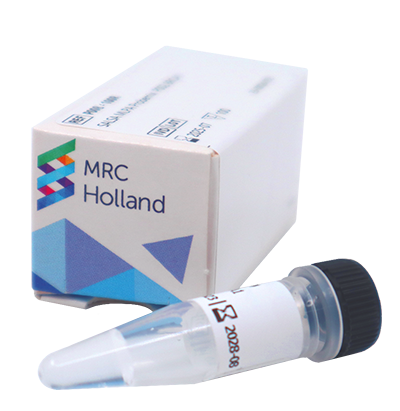
SALSA MLPA Probemix P472 SUFU detects copy number variations in the SUFU gene.
Contents: 30 MLPA probes, including 15 probes for SUFU.
Tissue: human genomic DNA, including DNA from FFPE tissue.
Application: research on Gorlin syndrome, and predisposition to several cancer types.
For research use only (RUO). Not for use in diagnostics.
The SALSA MLPA Probemix P472 SUFU is a research use only (RUO) assay for the detection of deletions or duplications in the SUFU gene, which is associated with Gorlin syndrome and predisposition to several cancer types.
The SUFU gene (OMIM 607035) encodes a component of the Sonic hedgehog (SHH)/Patched (PTCH) signalling pathway. Mutations in the SUFU gene are expected to result in the same clinical phenotype as mutations in the better known PTCH1 gene (OMIM 601309). Screening for the SUFU gene is therefore suggested when the PTCH1 gene is wildtype in patients with clinical basal cell nevus (Gorlin) syndrome (OMIM#109400). Germline mutations in the SUFU gene are suggested to predispose to infant desmoplastic/ nodular medulloblastomas, basal cell carcinomas and meningiomas. This SUFU susceptibility gene shows autosomal dominant inheritance with an incomplete penetrance. In addition to point mutations, both whole SUFU gene duplications and partial SUFU gene deletions have been described (Brugieres et al. 2012; Smith et al. 2014; Kenawy et al. 2019).
More information is available at https://www.ncbi.nlm.nih.gov/books/NBK1151/
SALSA MLPA Probemix P472 SUFU is for research use only (RUO) in all territories.
A general SALSA MLPA Reagent Kit is required for MLPA experiments (to be ordered separately).
The prices above are list prices for direct orders from MRC Holland. Contact us for a quote that takes discounts and additional costs (such as shipping costs) into account. Different prices apply for orders through one of our sales partners; contact your local supplier for a quote.
Inclusion of a positive sample is usually not required, but can be useful for the analysis of your experiments. MRC Holland has very limited access to positive samples and cannot supply such samples. We recommend using positive samples from your own collection. Alternatively, you can use positive samples from an online biorepository, such as the Coriell Institute.
See this support article for commercially available positive samples that can be used with this product.