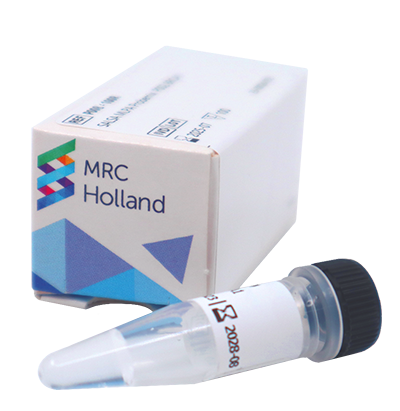
SALSA MLPA Probemix P465 ACADM detects copy number variations in the ACADM gene.
Contents: 27 MLPA probes, including 15 probes for ACADM of which 1 detects the wild-type sequence of the c.985A>G (p.Lys329Glu) mutation.
Tissue: human genomic DNA.
Application: research on medium-chain acyl-coenzyme A dehydrogenase deficiency (MCAD).
For research use only (RUO). Not for use in diagnostics.
The SALSA MLPA Probemix P465 ACADM is a research use only (RUO) assay for the detection of deletions or duplications in the ACADM gene, which is associated with Medium-Chain Acyl-Coenzyme A Dehydrogenase Deficiency (MCAD). This probemix can also be used to detect the presence of the wild-type sequence of c.985A>G/p.Lys329Glu (rs77931234) point mutation.
MCAD (OMIM 201450) is a disorder of fatty acid β-oxidation. Fatty acid β-oxidation fuels hepatic ketogenesis, a major source of energy for peripheral tissues once glycogen stores become depleted. This disorder is characterised by intolerance to prolonged fasting, impaired ketogenesis, low plasma and tissue carnitine levels, among others. The disorder may be severe, and even fatal, in young patients. Defects in the ACADM gene on chromosome 1 are the main cause of MCAD. Most of the known pathologic defects are point mutations but several articles describe small and large deletions of the ACADM gene.
More information is available at https://www.ncbi.nlm.nih.gov/books/NBK1424/.
SALSA MLPA Probemix P465 ACADM is for research use only (RUO) in all territories.
A general SALSA MLPA Reagent Kit is required for MLPA experiments (to be ordered separately).
The prices above are list prices for direct orders from MRC Holland. Contact us for a quote that takes discounts and additional costs (such as shipping costs) into account. Different prices apply for orders through one of our sales partners; contact your local supplier for a quote.
Inclusion of a positive sample is usually not required, but can be useful for the analysis of your experiments. MRC Holland has very limited access to positive samples and cannot supply such samples. We recommend using positive samples from your own collection. Alternatively, you can use positive samples from an online biorepository, such as the Coriell Institute.
We have no information about specific commercially available positive samples that can be used with this product.