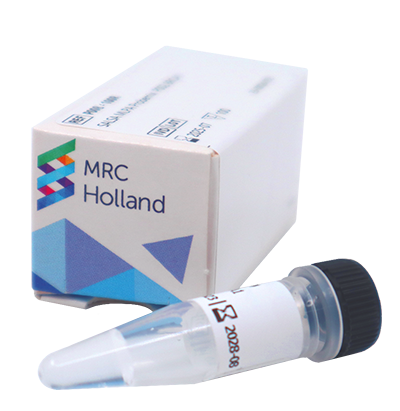
SALSA MLPA Probemix P433 ARID1A-ARID1B detects copy number variations in the ARID1A and ARID1B genes.
Contents: 56 MLPA probes, including 22 probes for ARID2A, and 22 probes for ARID1B.
Tissue: human genomic DNA, including DNA from FFPE tissue.
Application: research on various tumour types, Coffin-Siris syndrome, and non-syndromic intellectual disability.
For research use only (RUO). Not for use in diagnostics.
SALSA MLPA Probemix P433 ARID1A-ARID1B is a research use only (RUO) assay for the detection of deletions or duplications in the ARID1A and ARID1B genes, which are associated with various tumour types, Coffin-Siris syndrome (OMIM #614607) and non-syndromic intellectual disability (OMIM #614562).
ARID1A (AT-rich interactive domain 1A) and ARID1B (AT-rich interactive domain 1B) proteins share 80% amino acid homology and are evolutionarily conserved. These proteins are integral components of the SWI/SNF chromatin modelling complex, which mediates epigenetic regulation in critical cellular processes such as cell differentiation, proliferation and DNA repair (Madan V et al. 2023).
Alterations in ARID1A and ARID1B genes are typically loss-of-function changes and they can exhibit bi-allelic inactivation or loss of protein expression, consistent with a tumour suppressor mechanism (Garraway and Lander, 2013). ARID1A is frequently mutated across a wide variety of human cancers, whereas alterations in ARID1B have been detected at lower frequencies. ARID1A and ARID1B genetic alterations have been identified in 11% of childhood neuroblastoma and are associated with early treatment failure and decreased survival (Sausen et al. 2012). Furthermore, ARID1A inactivating mutations have been detected in approximately 50% of ovarian clear cell carcinomas (Jones et al. 2010, Wiegand et al. 2010, Caumanns JJ et al. 2018), in up to 17% of hepatocellular carcinomas (Guichard et al. 2012, Fujimoto et al. 2012, Huang et al. 2012), in 10-29% of gastric cancer cases (Wang et al. 2011, Zang et al. 2012) and in 37% of breast cancers (Cornen et al. 2012). Importantly, it has been shown that ARID1A-deficiency sensitizes cancer cells to PARP inhibitor therapies, providing new treatment possibilities for ARID1A-mutant tumours (Shen et al. 2015; Park et al. 2019; Yu et al. 2023).
Genetic alterations in ARID1A (<5%) and ARID1B (~37%) have also been detected in Coffin-Siris syndrome and non-syndromic intellectual disability cases. ARID1A microduplications cause intellectual disability with recognizable syndromic features (Bidart et al. 2017), whereas intragenic duplications and microdeletions of ARID1B have been described in patients with severe intellectual disability (Hoyer et al. 2012). ARID1B alterations have also been found in patients with Coffin-Siris syndrome (Santen et al. 2012, Tsurusaki et al. 2012) and in patients affected with either syndromic or non-syndromic short stature (Yu et al. 2015).
SALSA MLPA Probemix P433 ARID1A-ARID1B is for research use only (RUO) in all territories.
A general SALSA MLPA Reagent Kit is required for MLPA experiments (to be ordered separately).
These optional accessories can be ordered separately.
The prices above are list prices for direct orders from MRC Holland. Contact us for a quote that takes discounts and additional costs (such as shipping costs) into account. Different prices apply for orders through one of our sales partners; contact your local supplier for a quote.
Inclusion of a positive sample is usually not required, but can be useful for the analysis of your experiments. MRC Holland has very limited access to positive samples and cannot supply such samples. We recommend using positive samples from your own collection. Alternatively, you can use positive samples from an online biorepository, such as the Coriell Institute.
See this support article for commercially available positive samples that can be used with this product.