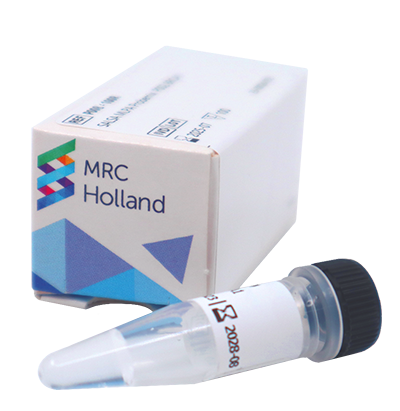
SALSA MLPA Probemix P351 PKD1 and SALSA MLPA Probemix P352 PKD1-PKD2 detect copy number variations in the PKD1, PKD2 and TSC2 genes.
Contents: P351 PKD1 and P352 PKD1-PKD2 together contain 88 MLPA probes, including 45 probes for PKD1, 18 probes for PKD2, and 3 probes for TSC2.
Tissue: genomic DNA isolated from human peripheral whole blood.
Application: autosomal dominant polycystic kidney disease (ADPKD), and TSC2/PKD1 contiguous gene deletion syndrome.
IVDR certified for in vitro diagnostic (IVD) use.
This product has recently been CE-marked for in vitro diagnostic (IVD) use under the In Vitro Diagnostic Regulation (IVDR; EU 2017/746), which replaces the former CE-marking under the IVD Directive (IVDD; Directive 98/79/EC). This update was accompanied by a change in the intended purpose and a change in format of the product description. Some information can now be found in a different location (more information).
The SALSA MLPA Probemix P351 PKD1 and SALSA MLPA Probemix P352 PKD1-PKD2 are in-vitro diagnostic (IVD) semi-quantitative manual assays for the detection of deletions or duplications in the PKD1 gene and deletions in the PKD2 gene, in order to confirm a potential cause for or clinical diagnosis of autosomal dominant polycystic kidney disease (ADPKD). P351 PKD1 can also be used to detect deletions in exons 36, 38, and 42 of the TSC2 gene. Deletions disrupting both PKD1 and TSC2 can confirm a potential cause for and clinical diagnosis of TSC2/PKD1 contiguous gene deletion syndrome. Both assays are for use with genomic DNA isolated from human peripheral whole blood specimens, and are also intended for molecular genetic testing of at-risk family members.
For the full intended purpose, see the product description.
Autosomal dominant polycystic kidney disease (ADPKD), the most common hereditary kidney disease, is characterised by bi-lateral development and expansion of renal cysts, hypertension and a progressive decline in renal function. In ~50% of affected individuals, ADPKD results in end-stage renal disease (ESRD), and 4-10% of ESRD worldwide is due to ADPKD. Although the kidney is the main organ involved, ADPKD is a multisystem disorder with profound extra-renal manifestations, including liver cysts and intracranial aneurysms. There is a substantial intra- and interfamilial variability in the severity of both renal and extra-renal disease manifestations. ADPKD is typically a late-onset disease diagnosed in adulthood, but about 2-5% of the ADPKD patients show a very early onset of the disease (during childhood or even prenatally) and a severe phenotype.
ADPKD is caused by heterozygous pathogenic mutations in either the PKD1, PKD2, GANAB, DNAJB11, ALG5, ALG9 or IFT140 genes (Besse et al. 2019; Cornec-Le Gall et al. 2018; Lemoine et al. 2022; Porath et al. 2016; Senum et al. 2022). Most patients carry a defect in PKD1 (~78%) or PKD2 (~15%), whereas a minority of the cases is explained by defects in GANAB (<0.5%), DNAJB11 (<0.5%), ALG5 (<0.5%), ALG9 (<0.5%) and IFT140 (1-2%). In ~5% of the cases, the underlying genetic defect is unknown. Patients with a PKD1 mutation, especially those with truncating mutations, generally have a more rapidly progressive disease with an earlier onset of ESRD than patients with a PKD2 mutation. It is estimated that ~3% of the PKD1 deletions or duplications and ~3% of the PKD2 mutations are deletions (Carrera et al. 2016; Consugar et al. 2008; Schonauer et al. 2020; Xu et al. 2018). More information about ADPKD is available at https://www.ncbi.nlm.nih.gov/books/NBK1246/.
TSC2/PKD1 contiguous gene deletion syndrome is a disorder in which the phenotypes of tuberous sclerosis complex and ADPKD are combined. Tuberous sclerosis complex is a neurocutaneous disorder that involves abnormalities of the skin, brain, kidney, heart and lungs. When combined with ADPKD, it is characterised by a very early onset of severe polycystic kidney disease, that is diagnosed in utero or in infancy. The PKD1 gene lies directly adjacent to the TSC2 gene in a tail-to-tail orientation. Large PKD1 deletions that also disrupt the adjacent TSC2 gene result in TSC2/PKD1 contiguous gene deletion syndrome (Consugar et al. 2008).
SALSA MLPA Probemix P352 PKD1-PKD2 is CE-marked under the IVDR for in vitro diagnostic (IVD) use in Europe.
This assay is for research use only (RUO) in all other territories.
Translations of the product description in selected European languages are available upon request. Please contact us or one of our local sales partners. Translations of the MLPA General Protocol in selected languages are available here.
The Summary of Safety and Performance (SSP) is also available upon request.
A general SALSA MLPA Reagent Kit is required for MLPA experiments (to be ordered separately).
The prices above are list prices for direct orders from MRC Holland. Contact us for a quote that takes discounts and additional costs (such as shipping costs) into account. Different prices apply for orders through one of our sales partners; contact your local supplier for a quote.
Inclusion of a positive sample is usually not required, but can be useful for the analysis of your experiments. MRC Holland has very limited access to positive samples and cannot supply such samples. We recommend using positive samples from your own collection. Alternatively, you can use positive samples from an online biorepository, such as the Coriell Institute.
The commercially available positive samples below can be used with the current (E1) version of this product.