SALSA MLPA Probemix P348 ATP1A2-CACNA1A-PRRT2 detects copy number variations in the ATP1A2, CACNA1A and PRRT2 genes.
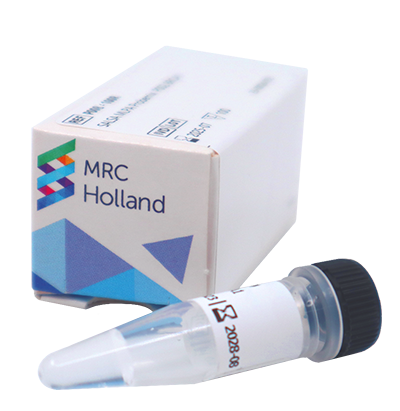
Contents: 49 MLPA probes, includes 21 probes for ATP1A2, 15 probes for CACNA1A and 5 probes for PRRT2.
Tissue: human genomic DNA.
Application: research on familial hemiplegic migraine (FHM).
For research use only (RUO). Not for use in diagnostics.
The SALSA MLPA Probemix P348 ATP1A2-CACNA1A-PRRT2 is a research use only (RUO) assay for the detection of deletions or duplications in the ATP1A2, CACNA1A and PRRT2 genes, which are associated with familial hemiplegic migraine (FHM).
Migraine is a common neurological disorder that affects up to 15% of the general population (Vos et al. 2012). FHM is a rare autosomal dominantly inherited subtype of migraine with aura. In case of FHM, the aura usually consist of a phase with hemiparesis accompanied by typical aura symptoms, including visual, sensory or speech disturbances, followed by a headache phase (Jen JC. 2015). Four genes have been identified for different types of FHM: CACNA1A, ATP1A2, SCN1A and the more recently identified gene PRRT2 (Friedrich et al. 2016).
The ATP1A2 gene (23 exons) spans ~28 kb of genomic DNA and is located on 1q23.2, ~160 Mb from the p-telomere.
The CACNA1A gene (47 exons) spans ~300 kb of genomic DNA and is located on 19p13, ~13 Mb from the p-telomere.
The PRRT2 gene (4 exons) spans ~3.7 kb of genomic DNA and is located on 16p11.2, ~30 Mb from the p-telomere.
More information is available at https://www.ncbi.nlm.nih.gov/books/NBK1388/.
SALSA MLPA Probemix P348 ATP1A2-CACNA1A-PRRT2 is for research use only (RUO) in all territories.
A general SALSA MLPA Reagent Kit is required for MLPA experiments (to be ordered separately).
The prices above are list prices for direct orders from MRC Holland. Contact us for a quote that takes discounts and additional costs (such as shipping costs) into account. Different prices apply for orders through one of our sales partners; contact your local supplier for a quote.
Inclusion of a positive sample is usually not required, but can be useful for the analysis of your experiments. MRC Holland has very limited access to positive samples and cannot supply such samples. We recommend using positive samples from your own collection. Alternatively, you can use positive samples from an online biorepository, such as the Coriell Institute.
See this support article for commercially available positive samples that can be used with this product.