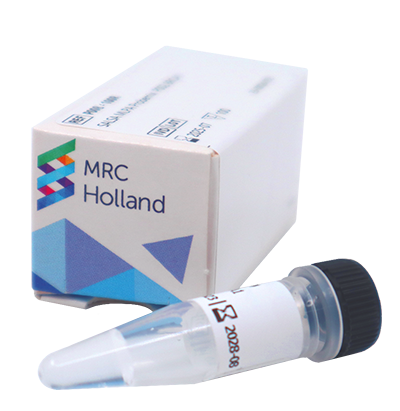
SALSA MLPA Probemix P324 22q11 detects copy number variations in the 22q11 region.
Contents: 40 MLPA probes, including 28 probes for the 22q11 region (of which 7 probes target TBX1) and 1 probe for 22q12.1 region.
Tissue: human genomic DNA.
Application: research on 22q11.2 distal deletion syndrome, 22q11.2 microduplication syndrome, DiGeorge syndrome (DGS), velocardiofacial syndrome (VCFS) and cat eye syndrome (CES).
For research use only (RUO). Not for use in diagnostics.
The SALSA MLPA Probemix P324 22q11 is a research use only (RUO) assay for the detection of deletions or duplications in the 22q11 chromosomal region. Microdeletions/-duplications in the 22q11.2 region cause a variety of disorders, including the 22q11.2 distal deletion syndrome (MIM 611867), the 22q11.2 microduplication syndrome (MIM 608363), DiGeorge syndrome (DGS; MIM 188400), velocardiofacial syndrome (VCFS; MIM 192430) and cat eye syndrome (CES; MIM 115470). We recommend the use of the SALSA MLPA Probemix P250 DiGeorge as a primary screening for DiGeorge syndrome.
The high frequency of 22q11.2 copy number changes is due to the presence of several low copy repeats (LCRs), labelled A-H, which facilitate misalignment. The overall birth prevalence of 22q11.2 deletions appears to be approximately 1 in 4,000. The 22q11.2 deletion syndrome is inherited in an autosomal dominant manner, with about 93% of probands having a de novo deletion, whereas the remaining 7% of probands have inherited the 22q11.2 deletion from a parent. The 22q11.2 deletion syndrome, which includes DGS and VCFS, most often (85%) results from a 3 Mb deletion on the 22q11.2 region. This 3 Mb deleted region is flanked by LCR-A and LCR-D, and includes the TBX1 gene. The remaining 15% of affected individuals have smaller, atypical deletions, which can include LCR A-B, B-D or C-D deletions. Haploinsufficiency of the TBX1 gene in particular is responsible for most of the physical malformations. Point mutations in this gene have also been observed in individuals with DGS. The phenotype of individuals with 22q11.2 deletion syndrome is characterised by palatal anomalies, congenital heart problems and distinct facial features. More information is available at https://www.ncbi.nlm.nih.gov/books/NBK1523/.
The 22q11.2 microduplication syndrome is inherited in an autosomal dominant manner. Most individuals with a 22q11.2 duplication have inherited the duplication from a parent, but de novo 22q11.2 duplications also occur. The penetrance of 22q11.2 duplication is incomplete. The phenotype is generally mild and highly variable. It is characterised by intellectual disability, delayed psychomotor development, growth retardation and/or hypotonia. More information is available at https://www.ncbi.nlm.nih.gov/books/NBK3823/.
CES has a large clinical variability, ranging from marginally affected individuals to those with the full pattern of malformations and a lethal outcome. The eyes are predominantly affected. CES is caused by a small, dicentric, supernumerary chromosome 22 representing an inv dup (22)(q11). In many cases this chromosomal abnormality is mosaic.
SALSA MLPA Probemix P324 22q11 is for research use only (RUO) in all territories.
A general SALSA MLPA Reagent Kit is required for MLPA experiments (to be ordered separately).
The prices above are list prices for direct orders from MRC Holland. Contact us for a quote that takes discounts and additional costs (such as shipping costs) into account. Different prices apply for orders through one of our sales partners; contact your local supplier for a quote.
Inclusion of a positive sample is usually not required, but can be useful for the analysis of your experiments. MRC Holland has very limited access to positive samples and cannot supply such samples. We recommend using positive samples from your own collection. Alternatively, you can use positive samples from an online biorepository, such as the Coriell Institute.
The commercially available positive samples below can be used with the current (B1) version of this product.