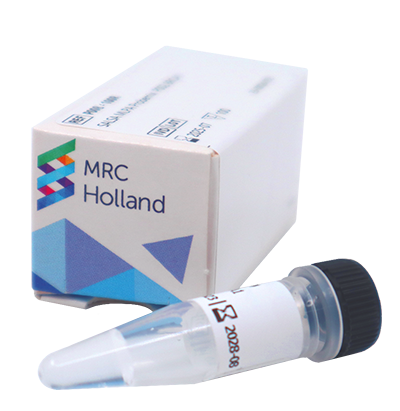
SALSA MLPA Probemix P315 EGFR detects copy number variations in the EGFR gene.
Contents: 47 MLPA probes, including 28 probes for EGFR and probes for EGFR c.2573T>G (p.L858R) and c.2369C>T (p.T790M).
Tissue: human genomic DNA, including DNA from FFPE tissue.
Application: research on epidermal growth factor receptor (EGFR).
For research use only (RUO). Not for use in diagnostics.
The SALSA MLPA Probemix P315 EGFR is a research use only (RUO) assay for the detection of deletions or duplications in the human EGFR gene. This probemix can also be used to detect the presence of EGFR c.2573T>G=p.L858R and c.2369C>T=p.T790M point mutations.
The epidermal growth factor receptor (EGFR) is a cell surface tyrosine kinase (TK) enzyme involved in controlling cell growth. Ligand-induced stimulation of EGFR followed by subsequent formation of homodimers or heterodimers with other receptors, results in the activation of downstream signalling cascades that regulate cell proliferation, differentiation, survival and DNA synthesis (Kovacs et al., 2015; Wee et al., 2017). Various genetic alterations resulting in oncogenic activity of EGFR have been described to be pivotal in tumour development and progression in multiple cancer types (Lynch et al., 2004; Bhargava et al., 2005; Brennan et al., 2013). Moreover, patients with tumours harbouring EGFR alterations tend to have a more aggressive form of the disease, and expression levels of EGFR are highly predictive of clinical outcome for cancer patients (Uribe et al., 2021).
Genetic alterations that result in oncogenic activity of EGFR in cancer include copy number amplifications and deletions, structural rearrangements of the gene, and activating mutations (Lynch et al., 2004; Bhargava et al., 2005; Brennan et al., 2013). One of the most common EGFR deletions detected in various tumour types is the EGFR deletion variant III (EGFRvIII), resulting from an in-frame deletion of exons 2-7 leading to a ligand-independent receptor (Gan et al., 2013). In addition, numerous other EGFR (exon) deletions and duplications are found in tumour biopsies. EGFR mutations cluster in the kinase domain of EGFR (exons 18-21), and cause ligand-independent activation of the receptor. Therefore, these activating mutations represent possible targets for therapeutic intervention. In this regard, certain somatic EGFR mutations as well as gene amplification in patients with non-small cell lung cancer (NSCLC) highly correlate with the clinical response to TK inhibitors. Two frequent EGFR mutations, c.2573T>G=p.L858R and c.2369C>T=p.T790M, are shown to be an important mechanism of resistance to drugs acting on the TK domain of EGFR (Uribe et al. 2021).
SALSA MLPA Probemix P315 EGFR is for research use only (RUO) in all territories.
SALSA Binning DNA SD006 is an artificial DNA sample with a signal for all probes in the P315 EGFR probemix. Inclusion of a reaction with SD006 in initial experiments and in experiments following a change in electrophoresis conditions is recommended to aid in the creation of a bin set that links peaks to the probes that produce them. Binning DNA cannot be used as a reference sample in the MLPA data analysis, and cannot be used to quantify the signals of mutation-specific probes.
A vial of SALSA Binning DNA SD006 is included with every order of the P315 EGFR probemix, but it is possible to order additional vials separately.
For more information, see the product description.
A general SALSA MLPA Reagent Kit is required for MLPA experiments (to be ordered separately).
A vial is included with every order of this probemix, but additional vials can also be purchased separately.
The prices above are list prices for direct orders from MRC Holland. Contact us for a quote that takes discounts and additional costs (such as shipping costs) into account. Different prices apply for orders through one of our sales partners; contact your local supplier for a quote.
Inclusion of a positive sample is usually not required, but can be useful for the analysis of your experiments. MRC Holland has very limited access to positive samples and cannot supply such samples. We recommend using positive samples from your own collection. Alternatively, you can use positive samples from an online biorepository, such as the Coriell Institute.
The commercially available positive samples below can be used with the current (C2) version of this product.