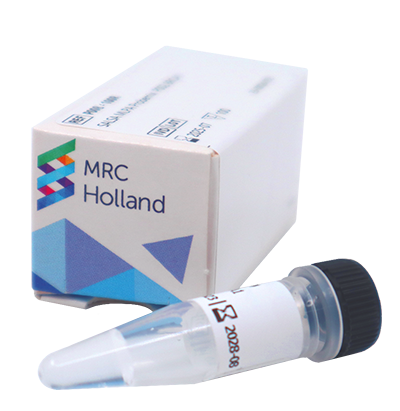
SALSA MLPA Probemix P305 AGXT detects copy number variations of AGXT and GRHPR genes.
Contents: 31 MLPA probes including 12 probes for AGXT (covering all exons), 8 probes for GRHPR, and 3 probes for AGXT c.731T>C, c.33_34insC and c.508G>A.
Tissue: human genomic DNA
Application: research on primary hyperoxaluria type 1 and 2.
For research use only (RUO). Not for use in diagnostics.
The SALSA MLPA Probemix P305 AGXT is a research use only (RUO) assay for the detection of deletions or duplications in the AGXT and GRHPR genes, which are associated with primary hyperoxaluria type 1 and 2. This probemix can also be used to detect the presence of the AGXT c.731T>C (p.I244T), c.33_34insC (c.33dupC; p.Lys12GlnfsX156) and c.508G>A (p.G170R) point mutations.
Primary hyperoxaluria type 1 and 2 are each caused by a deficiency of an enzyme that catalyses glyoxylate conversion (alanine-glyoxylate aminotransferase encoded by AGXT and glyoxylate reductase/hydroxypyruvate reductase encoded by GRHPR, respectively). This deficiency results in the production of oxalate, which accumulates in the form of calcium oxalate crystals. Persistent hyperoxaluria causes nephrolithiasis and nephrocalcinosis, leading to renal failure, followed by tissue oxalosis with life-threatening complications. There are three types of primary hyperoxaluria, of which type 1 is the most severe, followed by type 2. Both type 1 and type 2 are inherited in an autosomal recessive manner (Howles and Thakker. 2020).
The AGXT gene (11 exons) spans ~11.7 kb of genomic DNA and is located on 2q37.3, 241.5 Mb from the p-telomere (only 1.5 Mb from the q-telomere). The GRHPR gene (9 exons) spans ~14.3 kb of genomic DNA and is located on 9p13.2, 37.4 Mb from the p-telomere.
More information is available at https://www.ncbi.nlm.nih.gov/books/NBK1283/ and https://www.ncbi.nlm.nih.gov/books/NBK2692/.
SALSA MLPA Probemix P305 AGXT is for research use only (RUO) in all territories.
SALSA Binning DNA SD030 is an artificial DNA sample with a signal for all probes in the P305 AGXT probemix. Inclusion of a reaction with SD030 in initial experiments and in experiments following a change in electrophoresis conditions is recommended to aid in the creation of a bin set that links peaks to the probes that produce them. Binning DNA cannot be used as a reference sample in the MLPA data analysis, and cannot be used to quantify the signals of mutation-specific probes.
A vial of SALSA Binning DNA SD030 is included with every order of the P305 AGXT probemix, but it is possible to order additional vials separately.
For more information, see the product description.
A general SALSA MLPA Reagent Kit is required for MLPA experiments (to be ordered separately).
A vial is included with every order of this probemix, but additional vials can also be purchased separately.
The prices above are list prices for direct orders from MRC Holland. Contact us for a quote that takes discounts and additional costs (such as shipping costs) into account. Different prices apply for orders through one of our sales partners; contact your local supplier for a quote.
Inclusion of a positive sample is usually not required, but can be useful for the analysis of your experiments. MRC Holland has very limited access to positive samples and cannot supply such samples. We recommend using positive samples from your own collection. Alternatively, you can use positive samples from an online biorepository, such as the Coriell Institute.
The commercially available positive samples below can be used with the current (B3) version of this product.