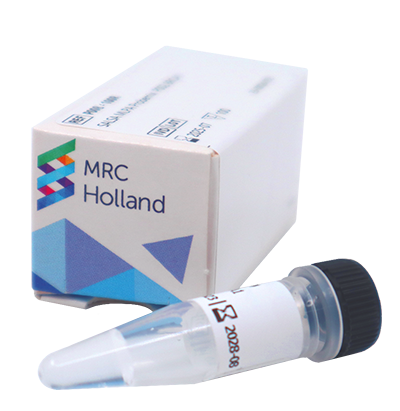
SALSA MLPA Probemix P272 COL1A2 detects copy number variations in the COL1A2 gene.
Contents: 43 MLPA probes, including 35 probes for COL1A2.
Tissue: human genomic DNA.
Application: research on osteogenesis imperfecta (OI).
For research use only (RUO). Not for use in diagnostics.
The SALSA MLPA Probemix P272 COL1A2 is a research use only (RUO) assay for the detection of deletions or duplications in the COL1A2 gene, which is associated with Osteogenesis Imperfecta (OI).
Type I collagen is the most common type of collagen. It is present in almost all connective tissues. This protein consists of three polypeptide chains: two alpha-1 polypeptide chains and one alpha-2 polypeptide chain, which are encoded by the COL1A1 gene and the COL1A2 gene, respectively.
OI is a genetic disorder characterised by bone fragility, severe bowing of long bones and low bone mass. The prevalence of this disorder ranges from one per 10,000 to one per 20,000 live births. Severe forms of OI lead to intrauterine fractures and perinatal lethality. Besides bone, other tissues rich in type I collagen are also affected, including skin, ligaments, and tendons. About 90% of the patients diagnosed with OI have mutations in the COL1A1 or COL1A2 genes.
More information is available at https://www.ncbi.nlm.nih.gov/books/NBK1295/.
SALSA MLPA Probemix P272 COL1A2 is for research use only (RUO) in all territories.
A general SALSA MLPA Reagent Kit is required for MLPA experiments (to be ordered separately).
The prices above are list prices for direct orders from MRC Holland. Contact us for a quote that takes discounts and additional costs (such as shipping costs) into account. Different prices apply for orders through one of our sales partners; contact your local supplier for a quote.
Inclusion of a positive sample is usually not required, but can be useful for the analysis of your experiments. MRC Holland has very limited access to positive samples and cannot supply such samples. We recommend using positive samples from your own collection. Alternatively, you can use positive samples from an online biorepository, such as the Coriell Institute.
We have no information about specific commercially available positive samples that can be used with this product.