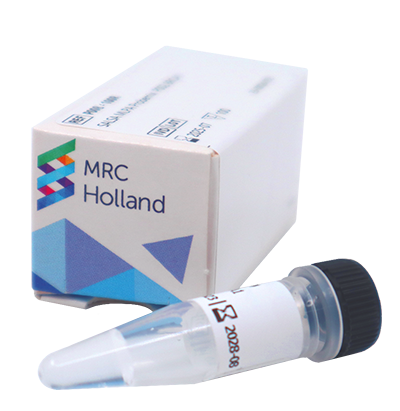
SALSA MLPA Probemix P214 COL2A1 detects copy number variations in the COL2A1 gene.
Contents: 57 MLPA probes, including 46 probes for COL2A1.
Tissue: human genomic DNA.
Application: research on type II collagen disorders.
For research use only (RUO). Not for use in diagnostics.
The SALSA MLPA Probemix P214 COL2A1 is a research use only (RUO) assay for the detection of deletions or duplications in the COL2A1 gene, which is associated with type II collagen disorders.
The COL2A1 gene (54 exons) spans ~31.5 kb of genomic DNA and is located on 12q13.11, ~47 Mb from the p-telomere. It encodes the pro-alpha-1 (II) chain of type II collagen, the major collagen found in cartilage and the vitreous humour of the eye. Defects in the COL2A1 gene lead to a number of different disorders, collectively called type II collagen disorders, which include amongst others achondrogenesis type 2, Stickler syndrome type 1, Kniest dysplasia, and spondyloepiphyseal dysplasia congenita. These disorders are characterised by abnormalities in the ocular, skeletal, orofacial, and audiological systems.
Mutations in COL2A1 have also been identified in individuals with chondrosarcoma, the second most common primary bone malignancy after osteosarcoma. Tarpey et al. (2013) reported insertions, deletions and rearrangements in 37% of the chondrosarcoma cases.
More information is available at https://www.ncbi.nlm.nih.gov/books/NBK540447/ (type II collagen disorders) and https://www.ncbi.nlm.nih.gov/books/NBK1302/ (Stickler syndrome).
SALSA MLPA Probemix P214 COL2A1 is for research use only (RUO) in all territories.
A general SALSA MLPA Reagent Kit is required for MLPA experiments (to be ordered separately).
The prices above are list prices for direct orders from MRC Holland. Contact us for a quote that takes discounts and additional costs (such as shipping costs) into account. Different prices apply for orders through one of our sales partners; contact your local supplier for a quote.
Inclusion of a positive sample is usually not required, but can be useful for the analysis of your experiments. MRC Holland has very limited access to positive samples and cannot supply such samples. We recommend using positive samples from your own collection. Alternatively, you can use positive samples from an online biorepository, such as the Coriell Institute.
We have no information about specific commercially available positive samples that can be used with this product.