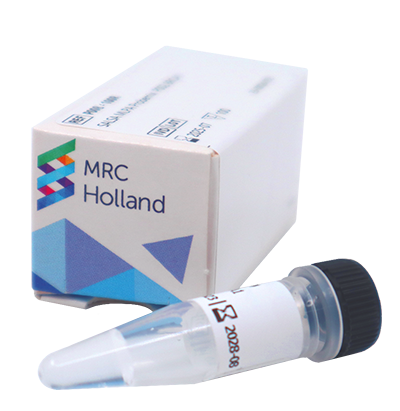
SALSA MLPA Probemix P494 NBN detects copy number variations in the NBN gene.
Contents: 27 MLPA probes, including 18 probes for the NBN region (covering all NBN exons).
Tissue: human genomic DNA.
Application: research on Nijmegen breakage syndrome (NBS).
For research use only (RUO). Not for use in diagnostics.
The SALSA MLPA Probemix P494 NBN is a research use only (RUO) assay for the detection of deletions or duplications in the NBN gene, which is associated with Nijmegen breakage syndrome.
Nijmegen breakage syndrome (NBS) is characterised by progressive microcephaly, intrauterine growth retardation and short stature, recurrent sinopulmonary infections, an increased risk of cancer, and premature ovarian failure in females. It is inherited in an autosomal recessive manner, but carriers have an increased risk of breast cancer (Bogdanova et al. 2008). The prevalence is unknown, but it is most common in the Central and Eastern European populations. The disease is caused by mutations in the NBN gene (previously known as NBS1). The NBN gene encodes nibrin, which is part of a double-strand break repair protein complex involved in cell-cycle checkpoint regulation (Varon et al. 1998).
The NBN gene (16 exons) spans ~51 kb of genomic DNA and is located on chromosome 8q21.3, ~91 Mb from the p-telomere.
More information is available at https://www.ncbi.nlm.nih.gov/books/NBK1176/.
SALSA MLPA Probemix P494 NBN is for research use only (RUO) in all territories.
A general SALSA MLPA Reagent Kit is required for MLPA experiments (to be ordered separately).
The prices above are list prices for direct orders from MRC Holland. Contact us for a quote that takes discounts and additional costs (such as shipping costs) into account. Different prices apply for orders through one of our sales partners; contact your local supplier for a quote.
Inclusion of a positive sample is usually not required, but can be useful for the analysis of your experiments. MRC Holland has very limited access to positive samples and cannot supply such samples. We recommend using positive samples from your own collection. Alternatively, you can use positive samples from an online biorepository, such as the Coriell Institute.
The commercially available positive samples below can be used with the current (A1) version of this product.