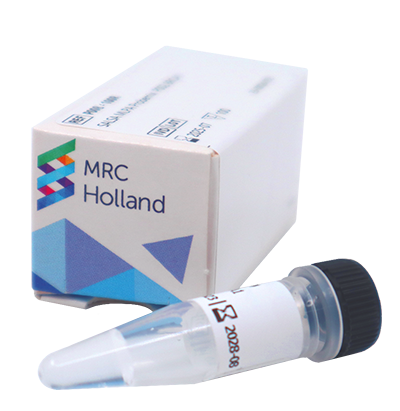
SALSA MLPA Probemix P318 Hirschsprung-2 detects copy number variations in the PHOX2B, GFRA3, GFRA2, GFRA1, EDNRB, NRTN, PSPN, and SOX10 genes.
Contents: 47 MLPA probes, including 3 probes each for PHOX2B, NRTN and PSPN, 5 probes each for GFRA3, GRFA2 and SOX10, 6 probes for GFRA1, and 8 probes for EDNRB.
Tissue: human genomic DNA.
Application: research on Hirschsprung disease (HSCR).
For research use only (RUO). Not for use in diagnostics.
The SALSA MLPA Probemix P318 Hirschsprung is a research use only (RUO) assay for the detection of deletions or duplications in the PHOX2B, GFRA3, GFRA2, GFRA1, EDNRB, NRTN, PSPN, and SOX10 genes, which are associated with Hirschsprung disease.
Hirschsprung disease is the main cause of functional intestinal obstruction. This disorder is characterised by the absence of the enteric ganglia along a variable length of the intestine. Two types of Hirschsprung disease have been described. The short-segment form, in which the aganglionic segment does not extend beyond the upper sigmoid, accounts for 80% of the cases. The long-segment form, in which aganglionosis extends proximal to the sigmoid, accounts for the remaining 20% of the cases. Both forms can be caused by dominant mutations in the RET gene (P169 Hirschsprung-1 probemix), as well as by recessive mutations in several other genes.
This P318 has been designed to detect deletions and duplications of one or more exons of eight genes involved in Hirschsprung disease: PHOX2B, GFRA3, GFRA2, GFRA1, EDNRB, NRTN, PSPN, and SOX10.
SALSA MLPA Probemix P318 Hirschsprung-2 is for research use only (RUO) in all territories.
A general SALSA MLPA Reagent Kit is required for MLPA experiments (to be ordered separately).
The prices above are list prices for direct orders from MRC Holland. Contact us for a quote that takes discounts and additional costs (such as shipping costs) into account. Different prices apply for orders through one of our sales partners; contact your local supplier for a quote.
Inclusion of a positive sample is usually not required, but can be useful for the analysis of your experiments. MRC Holland has very limited access to positive samples and cannot supply such samples. We recommend using positive samples from your own collection. Alternatively, you can use positive samples from an online biorepository, such as the Coriell Institute.
We have no information about specific commercially available positive samples that can be used with this product.