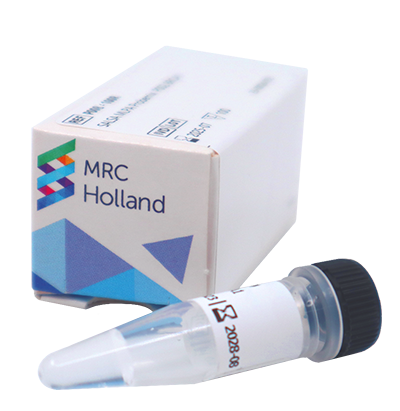
SALSA MLPA Probemix P312 POR detects copy number variations in the POR gene.
Contents: 29 MLPA probes, including 16 probes for POR.
Tissue: human genomic DNA.
Application: research on congenital adrenal hyperplasia (CAH) and Antley-Bixler syndrome.
For research use only (RUO). Not for use in diagnostics.
The SALSA MLPA Probemix P312 POR is a research use only (RUO) assay for the detection of deletions or duplications in the POR gene, which is associated with congenital adrenal hyperplasia (CAH) and Antley-Bixler syndrome.
The POR gene encodes Cytochrome P450 Oxidoreductase, a membrane-bound enzyme that serves as an electron donor for all microsomal cytochrome P450 enzymes. Specific deficiencies in the POR gene lead to clinical manifestations associated with CAH and Antley-Bixler syndrome.
In general, CAH is caused by deficiencies in cytochrome P450 (CYP) enzymes (e.g. CYP21A2) that are downstream in the electron transfer chain from POR (see P050 under 'related products'). Subsequently, POR deficient CAH is caused by the indirect impairment of these CYP enzymes.
Antley-Bixler syndrome is associated with mutations in the FGFR2 or POR gene. POR related disease is also thought to be caused by the effect dysfunctional POR has on downstream CYP enzymes (Krone et al. 2012).
More information is available at https://www.ncbi.nlm.nih.gov/books/NBK1419/.
SALSA MLPA Probemix P312 POR is for research use only (RUO) in all territories.
A general SALSA MLPA Reagent Kit is required for MLPA experiments (to be ordered separately).
The prices above are list prices for direct orders from MRC Holland. Contact us for a quote that takes discounts and additional costs (such as shipping costs) into account. Different prices apply for orders through one of our sales partners; contact your local supplier for a quote.
Inclusion of a positive sample is usually not required, but can be useful for the analysis of your experiments. MRC Holland has very limited access to positive samples and cannot supply such samples. We recommend using positive samples from your own collection. Alternatively, you can use positive samples from an online biorepository, such as the Coriell Institute.
We have no information about specific commercially available positive samples that can be used with this product.