SALSA MLPA Probemix P298 BRAF-HRAS-KRAS-NRAS detects copy number variations in the HRAS, KRAS, NRAS and BRAF genes.
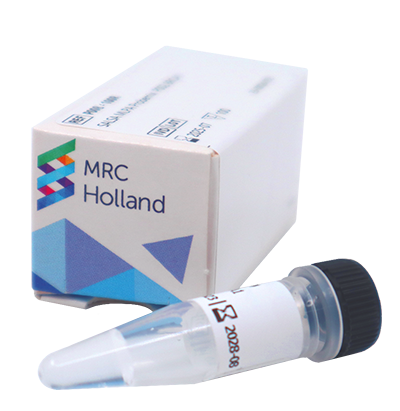
Contents: 57 MLPA probes, including 19 probes for BRAF, 7 probes for HRAS, 9 probes for KRAS, 7 probes for NRAS, and a probe for BRAF p.V600E (c.1799T>A).
Tissue: human genomic DNA, including DNA from FFPE tissue.
Application: research on the Ras/Raf/MEK/ERK pathway.
For research use only (RUO). Not for use in diagnostics.
This product is for basic research and intended for experienced users only! Interpretation of results may be complicated, and MRC Holland may only be able to provide basic support.
The SALSA MLPA Probemix P298 BRAF-HRAS-KRAS-NRAS is a research use only (RUO) assay for the detection of deletions or amplifications in the RAS genes (HRAS, KRAS and NRAS) and the BRAF gene, all core components of the Ras/Raf/MEK/ERK pathway. RAS genes (HRAS, KRAS, NRAS) code for small guanine-nucleotide-binding proteins which are essential for signalling networks controlling cellular proliferation, differentiation and survival. In the Ras/Raf/MEK/ERK pathway, RAS proteins are regulated by receptor tyrosine kinases (RTKs) which are activated upon growth factor binding. These RTKs mediate addition of an active GTP by GTPase activating proteins (GAPs) or an inactive GDP by GTP exchange factors (GEFs) (Simanshu et al., 2017). Downstream proteins will only be activated by the active RAS-GTP, but not by the inactive RAS-GDP. Oncogenic mutations in RAS occur in about 15% of human cancers, predominantly affecting the G12 residue of the protein. These oncogenic mutations result in the constitutive activation of RAS by keeping the protein in its GTP-bound state, thereby bypassing the need for growth factors to activate the pathway (Simanshu et al., 2017; Braicu et al. 2019).
BRAF is activated by RAS-GTP as a result of ligand-induced RTK activation in healthy cells. Mutations in the activating kinase domain of BRAF cause overactive downstream signalling via MEK and ERK, leading to excessive cell proliferation and survival independent of growth factors. The BRAF p.V600E (c.1799T>A) mutation is the most frequent mutation which confers oncogenic BRAF function (Davies et al., 2002; Braicu et al. 2019).
SALSA MLPA Probemix P298 BRAF-HRAS-KRAS-NRAS is for research use only (RUO) in all territories.
SALSA Binning DNA SD029 is an artificial DNA sample with a signal for all probes in the P298 BRAF-HRAS-KRAS-NRAS probemix. Inclusion of a reaction with SD029 in initial experiments and in experiments following a change in electrophoresis conditions is recommended to aid in the creation of a bin set that links peaks to the probes that produce them. Binning DNA cannot be used as a reference sample in the MLPA data analysis, and cannot be used to quantify the signals of mutation-specific probes.
A vial of SALSA Binning DNA SD029 is included with every order of the P298 BRAF-HRAS-KRAS-NRAS probemix, but it is possible to order additional vials separately.
For more information, see the product description.
A general SALSA MLPA Reagent Kit is required for MLPA experiments (to be ordered separately).
A vial is included with every order of this probemix, but additional vials can also be purchased separately.
The prices above are list prices for direct orders from MRC Holland. Contact us for a quote that takes discounts and additional costs (such as shipping costs) into account. Different prices apply for orders through one of our sales partners; contact your local supplier for a quote.
Inclusion of a positive sample is usually not required, but can be useful for the analysis of your experiments. MRC Holland has very limited access to positive samples and cannot supply such samples. We recommend using positive samples from your own collection. Alternatively, you can use positive samples from an online biorepository, such as the Coriell Institute.
The commercially available positive samples below can be used with the current (A2) version of this product.