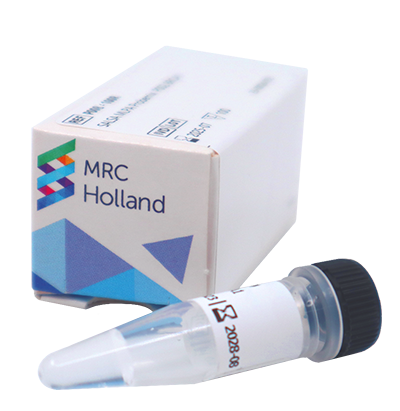
Choose your country to see the products for your location

P190 CHEK2

SALSA MLPA Probemix P190 CHEK2 detects copy number variations in the CHEK2, ATM and TP53 genes.

Specifications

Contents: 53 MLPA probes, including 19 probes for the CHEK2 region covering all 15 exons and including 1 probe for the CHEK2 c.1100delC mutation, 19 probes for ATM and 4 probes for TP53.

Tissue: genomic DNA isolated from human peripheral whole blood.

Application: predisposition to breast cancer and other CHEK2-related cancer types, ATM- or TP53-related predisposition to cancer.

IVDR certified and registered for in vitro diagnostic (IVD) use in selected territories.
Intended purpose

The SALSA MLPA Probemix P190 CHEK2 is an in vitro diagnostic (IVD) or research use only (RUO) semi-quantitative manual assay for the detection of deletions or duplications in the human CHEK2, and the presence of the CHEK2 c.1100delC mutation in genomic DNA isolated from human peripheral whole blood specimens. P190 CHEK2 is intended to confirm a potential cause for and clinical diagnosis of a predisposition to breast cancer and other CHEK2-related cancer types. In addition, deletions and duplications in the human ATM and TP53 genes can be detected with this probemix for differential diagnosis of ATM- or TP53-related predisposition to cancer, respectively, in patients originally suspected of a CHEK2-related cancer predisposition. This product can also be used to determine increased cancer susceptibility in at-risk family members.

For the full intended purpose, see the product description.

Clinical background

CHEK2, ATM and TP53 all play important roles in DNA damage repair. Pathogenic variants in these genes can increase cancer risk. For hereditary breast cancer, autosomal dominant variants in BRCA1 and BRCA2 are the most common high-penetrance causes, followed by moderate-risk genes including CHEK2, ATM and PALB2 (Buys et al. 2017). Pathogenic variants in CHEK2 may also increase the risk of developing colorectal cancer (Xiang et al. 2011) and other cancers, including prostate cancer (Cybulski et al. 2006). Pathogenic variants in CHEK2, particularly c.1100delC, result in a cancer predisposition syndrome now referred to as CHEK2-related cancer predisposition, or Tumor Predisposition Syndrome 4 (Hanson et al. 2023). CHEK2 carriers have an increased risk of cancers of the breast, prostate, colon, and kidney. For more information: https://omim.org/entry/609265.

CHEK2 variants were previously proposed as a cause of Li-Fraumeni syndrome type 2, but this has been refuted. Unlike Li-Fraumeni syndrome, which is primarily caused by TP53 mutations and characterized by sarcomas, adrenocortical tumors, brain tumors and early-onset breast cancer, CHEK2 carriers do not show this classic tumor spectrum.

CHEK2 exons 11-15 share a high sequence homology with several CHEK2 pseudogenes, which can result in a pseudogene-mediated gene conversion (Pan et al. 2017).

Autosomal dominant pathogenic variants in ATM are linked to an increased risk of cancer, with breast cancer in particular. Autosomal recessive pathogenic variants in ATM cause Ataxia-Telangiectasia, which is characterized by progressive cerebellar ataxia, telangiectases, and a predisposition to malignancy, particularly leukaemia and lymphoma. For more information: https://www.ncbi.nlm.nih.gov/books/NBK26468/.

Autosomal dominant pathogenic variants in TP53 result in LFS. The most common types of tumours in LFS are soft tissue sarcomas and osteosarcomas, pre-menopausal breast cancer, brain tumours, leukaemia, and adrenocortical carcinoma. Families presenting incomplete features of LFS are referred to as having LFL, and around 20-40% of these patients have a germline pathogenic variant in TP53 (Ruijs et al. 2010). More information on LFS: https://www.ncbi.nlm.nih.gov/books/NBK1311/.

Regulatory status

SALSA MLPA Probemix P190 CHEK2 is CE-marked under the IVDR for in vitro diagnostic (IVD) use in Europe. This assay is also registered for IVD use in Israel.

This assay is for research use only (RUO) in all other territories.

SALSA Sample DNA for this product

SALSA Binning DNA SD078 is an artificial DNA sample with a signal for all probes in the P190 CHEK2 probemix. Inclusion of a reaction with SD078 in initial experiments and in experiments following a change in electrophoresis conditions is recommended to aid in the creation of a bin set that links peaks to the probes that produce them. Binning DNA cannot be used as a reference sample in the MLPA data analysis, and cannot be used to quantify the signals of mutation-specific probes.

A vial of SALSA Binning DNA SD078 is included with every order of the P190 CHEK2 probemix, but it is possible to order additional vials separately.

For more information, see the product description.

Product documentation

Translations and Summary of Safety and Performance

Translations of the product description in selected European languages are available upon request. Please contact us or one of our local sales partners. Translations of the MLPA General Protocol in selected languages are available here.

The Summary of Safety and Performance (SSP) is also available upon request.

List prices

Product

Item no.
Description
Technology
Price
P190-025R
SALSA MLPA Probemix P190 CHEK2 – 25 rxn
€ 296.00
P190-050R
SALSA MLPA Probemix P190 CHEK2 – 50 rxn
€ 580.00
P190-100R
SALSA MLPA Probemix P190 CHEK2 – 100 rxn
€ 1135.00

Required reagents

A general SALSA MLPA Reagent Kit is required for MLPA experiments (to be ordered separately).

Item no.
Description
Technology
Price
EK1-FAM
SALSA MLPA Reagent Kit – 100 rxn – FAM (6 vials)
€ 361.00
EK1-CY5
SALSA MLPA Reagent Kit – 100 rxn – Cy5 (6 vials)
€ 361.00
EK5-FAM
SALSA MLPA Reagent Kit – 500 rxn – FAM (5×6 vials)
€ 1658.00
EK5-CY5
SALSA MLPA Reagent Kit – 500 rxn – Cy5 (5×6 vials)
€ 1658.00
EK20-FAM
SALSA MLPA Reagent Kit – 2000 rxn – FAM (5×6 vials)
€ 6373.00

Sample DNAs (included)

A vial is included with every order of this probemix, but additional vials can also be purchased separately.

Item no.
Description
Technology
Price
SD078
€ 25.00

Price details & ordering

The prices above are list prices for direct orders from MRC Holland. Contact us for a quote that takes discounts and additional costs (such as shipping costs) into account. Different prices apply for orders through one of our sales partners; contact your local supplier for a quote.

Positive samples

Inclusion of a positive sample is usually not required, but can be useful for the analysis of your experiments. MRC Holland has very limited access to positive samples and cannot supply such samples. We recommend using positive samples from your own collection. Alternatively, you can use positive samples from an online biorepository, such as the Coriell Institute.

The commercially available positive samples below can be used with the current (D1) version of this product.

ATM

CHEK2

  • Coriell HG00187: Positive for the CHEK2 c.1100delC mutation.
  • Coriell HG00343: Heterozygous deletion affecting the probes for CHEK2 exon 9-10.
  • Coriell HG01872: Heterozygous duplication affecting the probes for CHEK2 exon 3-5.
  • Coriell NA07106: Heterozygous duplication affecting the probes for CHEK2 and HSCB.

Publications

Selected publications using P190 CHEK2

  • Agiannitopoulos K et al. (2023). Copy Number Variations (CNVs) Account for 10.8% of Pathogenic Variants in Patients Referred for Hereditary Cancer Testing. Cancer Genomics Proteomics. 20:448-55.
  • Apostolou P et al. (2021). CHEK2 Pathogenic Variants in Greek Breast Cancer Patients: Evidence for Strong Associations with Estrogen Receptor Positivity, Overuse of Risk-Reducing Procedures and Population Founder Effects. Cancers (Basel). 13:2106.
  • Fostira F et al. (2020). One in three highly selected Greek patients with breast cancer carries a loss-of-function variant in a cancer susceptibility gene. J Med Genet. 57:53-61.
  • Havranek O et al. (2015). Association of Germline CHEK2 Gene Variants with Risk and Prognosis of Non-Hodgkin Lymphoma. PLoS One. 10:e0140819.
  • Lepkes L et al. (2021). Performance of In Silico Prediction Tools for the Detection of Germline Copy Number Variations in Cancer Predisposition Genes in 4208 Female Index Patients with Familial Breast and Ovarian Cancer. Cancers (Basel). 13:118.
  • Nizic-Kos T et al. (2021). Bilateral Disease Common Among Slovenian CHEK2-Positive Breast Cancer Patients. Ann Surg Oncol. 28:2561-70.
  • Nurmi AK et al. (2022). Pathogenic Variant Spectrum in Breast Cancer Risk Genes in Finnish Patients. Cancers (Basel). 14:6158.
  • Rolfes M et al. (2022). Prevalence of Cancer Predisposition Germline Variants in Male Breast Cancer Patients: Results of the German Consortium for Hereditary Breast and Ovarian Cancer. Cancers (Basel). 14:3292.
  • Tedaldi G et al. (2014). First evidence of a large CHEK2 duplication involved in cancer predisposition in an Italian family with hereditary breast cancer. BMC Cancer. 14:478.
  • Tsaousis GN et al. (2019). Analysis of hereditary cancer syndromes by using a panel of genes: novel and multiple pathogenic mutations. BMC Cancer. 19:535.
  • Vargas-Parra G et al. (2020). Comprehensive analysis and ACMG-based classification of CHEK2 variants in hereditary cancer patients. Hum Mutat. 41:2128-42.

References

  • Buys SS et al. (2017). A study of over 35,000 women with breast cancer tested with a 25-gene panel of hereditary cancer genes. Cancer. 123:1721-30.
  • Cybulski C et al. (2006). A large germline deletion in the Chek2 kinase gene is associated with an increased risk of prostate cancer. J Med Genet. 43:863-6.
  • Pan S et al. (2017). Apparent gene conversion event detected in CHEK2 using next generation sequencing analysis. Annual Clinical Genetics Meeting 2017. Poster 156.
  • Ruijs MWG et al. (2009). The contribution of CHEK2 to the TP53-negative Li-Fraumeni phenotype. Hered Cancer Clin Pract. 7:4.
  • Ruijs MWG et al. (2010). TP53 germline mutation testing in 180 families suspected of Li-Fraumeni syndrome: mutation detection rate and relative frequency of cancers in different familial phenotypes. J Med Genet. 47:421-8.
  • Xiang H-P et al. (2011). Meta-analysis of CHEK2 1100delC variant and colorectal cancer susceptibility. Eur J Cancer. 47:2546-51.

Sign in

Don't have an account? Create one

Forgot password?

Select Your Country

Choose your country to see the products for your location

CE

CE-marked products are for In Vitro Diagnostic (IVD) use only in EU (candidate) member states and members of the European Free Trade Association (EFTA), and the UK.

CE2797

CE-marked products are for In Vitro Diagnostic (IVD) use only in EU (candidate) member states and members of the European Free Trade Association (EFTA), and the UK.

IL

IVD-registered in Israel.