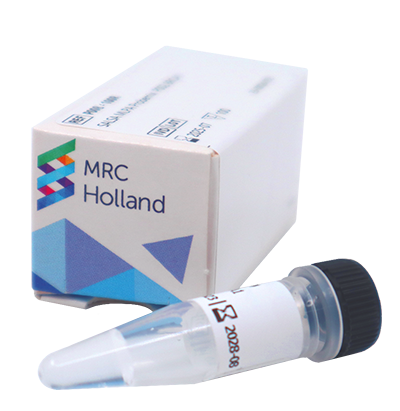
SALSA MLPA probemixes P141 NIPBL-1 and P142 NIPBL-2 detect copy number variations in the NIPBL gene.
Contents: P141 NIPBL-1 and P142 NIPBL-2 together contain 68 MLPA probes, including 48 probes for NIPBL (covering all exons).
Tissue: human genomic DNA.
Application: research on Cornelia de Lange syndrome (CdLS).
For research use only (RUO). Not for use in diagnostics.
The SALSA MLPA Probemixes P141 NIPBL-1 & P142 NIPBL-2 are research use only (RUO) assays for the detection of deletions or duplications in the NIPBL gene, which is associated with Cornelia de Lange syndrome (CdLS).
CdLS, also known as Bachmann-de Lange syndrome, is a multiple malformation disorder with characteristic facial features, growth and cognitive retardation, and a variety of other abnormalities affecting a wide range of tissues and organs. Most cases of CdLS are sporadic. Some familial cases have been reported, suggesting autosomal dominant inheritance. The incidence is 1 per 10,000-50,000 live births with no difference based on race or sex.
Among the genes associated with CdLS is the NIPBL gene, which is found mutated in 50-60% van CdLS cases. Other genes include the HDAC8, RAD21, SMC1A, and SMC3 genes, but no probes for these genes are included in these probemixes.
More information is available at https://www.ncbi.nlm.nih.gov/books/NBK1104/.
SALSA MLPA Probemix P142 NIPBL-2 is for research use only (RUO) in all territories.
A general SALSA MLPA Reagent Kit is required for MLPA experiments (to be ordered separately).
The prices above are list prices for direct orders from MRC Holland. Contact us for a quote that takes discounts and additional costs (such as shipping costs) into account. Different prices apply for orders through one of our sales partners; contact your local supplier for a quote.
Inclusion of a positive sample is usually not required, but can be useful for the analysis of your experiments. MRC Holland has very limited access to positive samples and cannot supply such samples. We recommend using positive samples from your own collection. Alternatively, you can use positive samples from an online biorepository, such as the Coriell Institute.
We have no information about specific commercially available positive samples that can be used with this product.