SALSA MLPA Probemix P125 Mitochondrial DNA detects copy number variations and several frequent mutations in human mitochondrial DNA (mtDNA).
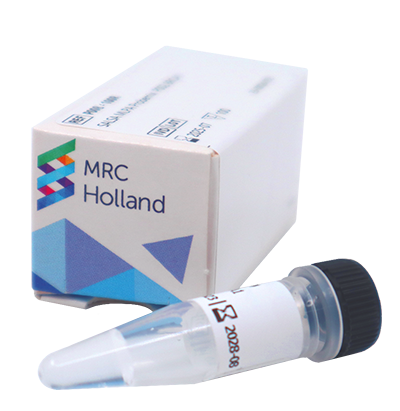
Contents: 46 MLPA probes for mtDNA, including 12 probes for the following mutations and their wild-type sequence: m.3243A>G (in TL1), m.3460G>A (in ND1), m.8344A>G (in TK), m.8993T>G (in ATP6), m.11778G>A (in ND4), and m.14484T>C (in ND6).
Tissue: human DNA.
Application: research on mitochondrial disorders, including Pearson syndrome, Kearns-Sayre syndrome, progressive external ophthalmoplegia, MERRF, MELAS, Leber hereditary optic neuropathy (LHON), Leigh syndrome, and NARP.
For research use only (RUO). Not for use in diagnostics.
The SALSA MLPA Probemix P125 Mitochondrial DNA is a research use only (RUO) assay for the detection of deletions or duplications in the human mitochondrial DNA and the presence and allele fraction of six different point mutations as described in Tables 1 and 2 in the product description.
Mitochondrial DNA (mtDNA) differs from nuclear DNA. The complete mitochondrial genome is circular and only 16,569 bp long. Only a small number of genes needed for mitochondrial functions are encoded by the mtDNA. The copy number of mitochondrial DNA is more than 100 fold higher as compared to genomic DNA. Most human cells contain over 200 copies of the mitochondrial genome.
The mutation rate in mtDNA is about 10 times higher than in nuclear DNA, probably due to an inferior repair system, the exposure to oxygen-free radicals generated by oxidative phosphorylation, and the lack of protective histones. The regions between nt 45-287 and between nt 16105-16348 are regarded as hypervariable. Mitochondrial DNA has no introns and hardly any intergenic regions. Most sequence changes will therefore affect a coding sequence. Transcription of mtDNA is polycistronic, which means that all genes encoded on the two ("heavy" and "light") DNA strands are transcribed as two large precursor RNA strands. A deletion anywhere in the mitochondrial genome may affect the transcription or translation of other genes, even when their sequence is intact. As a result, deletions of various sizes can cause similar phenotypes. Inherited anomalies of mtDNA are always maternal as all mitochondria come from the ovum.
Deletions in the mitochondrial DNA have been identified in various diseases including Pearson Syndrome, Kearns-Sayre Syndrome and Progressive external ophthalmoplegia. These deletions vary in size (1.3-8 kb) and location. The most common deletion region is between positions 8469 and 13147. Diseases caused by deletions and point mutations in mtDNA are characterised by heteroplasmy: a mixture of wild-type and mutant mtDNA is present in one cell. A deletion present in 35% of the mitochondria results in a 35% signal reduction of the affected MLPA probes. Please note that identical deletions can cause different diseases depending on the tissue in which they occur.
Some tandem duplications of parts of the mitochondrial genome have also been described, as well as a number of frequent mitochondrial point mutations resulting in a myopathy, such as MERRF and MELAS.
More information is available at:
Mitochondrial DNA mutation database: https://www.mitomap.org/MITOMAP.
SALSA MLPA Probemix P125 Mitochondrial DNA is for research use only (RUO) in all territories.
SALSA Binning DNA SD085 is an artificial DNA sample with a signal for all probes in the P125 Mitochondrial DNA probemix. Inclusion of a reaction with SD085 in initial experiments and in experiments following a change in electrophoresis conditions is recommended to aid in the creation of a bin set that links peaks to the probes that produce them. Binning DNA cannot be used as a reference sample in the MLPA data analysis, and cannot be used to quantify the signals of mutation-specific probes.
A vial of SALSA Binning DNA SD085 is included with every order of the P125 Mitochondrial DNA probemix, but it is possible to order additional vials separately.
For more information, see the product description.
A general SALSA MLPA Reagent Kit is required for MLPA experiments (to be ordered separately).
A vial is included with every order of this probemix, but additional vials can also be purchased separately.
The prices above are list prices for direct orders from MRC Holland. Contact us for a quote that takes discounts and additional costs (such as shipping costs) into account. Different prices apply for orders through one of our sales partners; contact your local supplier for a quote.
Inclusion of a positive sample is usually not required, but can be useful for the analysis of your experiments. MRC Holland has very limited access to positive samples and cannot supply such samples. We recommend using positive samples from your own collection. Alternatively, you can use positive samples from an online biorepository, such as the Coriell Institute.
The commercially available positive samples below can be used with the current (C1) version of this product.