The Potential of EZtec-MS for Newborn Screening
 As newborn screening (NBS) programs continue to expand, there is a growing need for technologies capable of detecting treatable genetic conditions that would otherwise be missed by traditional biochemical testing. While next generation sequencing (NGS) is increasingly being explored for NBS due to declining sequencing costs, technical, ethical, and economic challenges remain.
To address these challenges, MRC Holland has developed EZtec-MS, a new variation of the digitalMLPA technology. The first article describing this innovative approach has just been published in the European Journal of Human Genetics (EJHG). The study is the result of a collaborative effort between MRC Holland, Amsterdam UMC, and the University of the Philippines, co-led by Terence Diane Fabella and Joery den Hoed under the guidance of MRC Holland CEO Jan Schouten, who originally conceived the project.
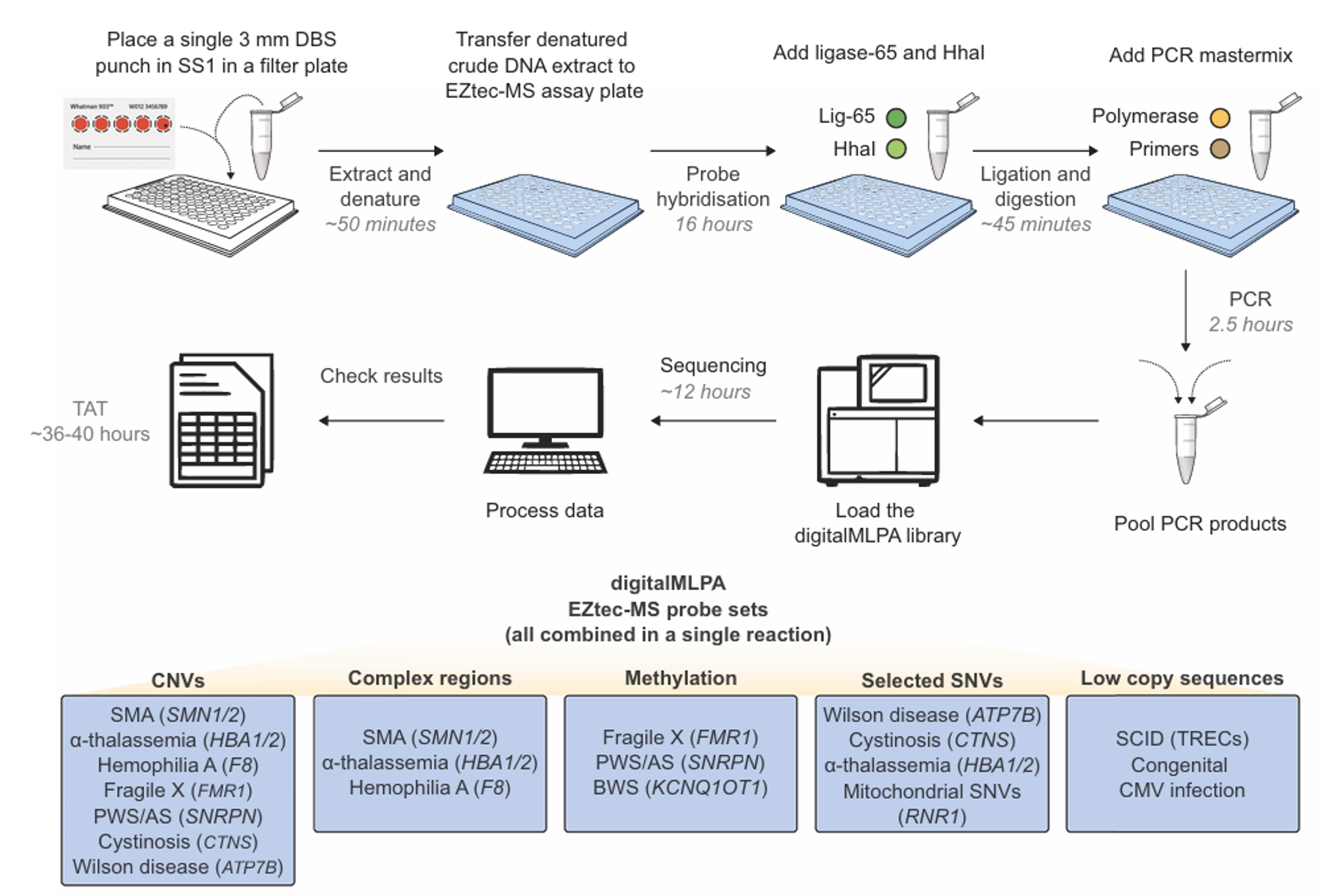
The publication presents an EZtec-MS assay specifically designed for use with crude extracts from dried blood spots (DBS), and targeting genomic regions of potential interest for first-tier newborn screening. The assay was evaluated using a cohort of 2,069 Filipino newborn samples that had previously tested negative for the 29 conditions currently included in the Philippine NBS program.
Why is EZtec-MS well suited for newborn screening?
The assay combines several features that are highly desirable in an NBS setting:
- A targeted design, limiting incidental findings and variants of uncertain significance, and avoiding the generation of large genomic datasets
- Direct analysis of crude DBS extracts, eliminating the need for DNA purification
- High-throughput workflow with the ability to process up to 384 samples in parallel
- Rapid turnaround time, with results available within 36-40 hours
- Simultaneous detection of multiple variant types in a single assay, demonstrated across a diverse set of positive samples:
- CNVs, including challenging homologous regions such as SMN1/SMN2 and HBA1/HBA2
- Selected single nucleotide variants (SNVs), e.g. in genes such as ATP7B and CTNS
- Methylation abnormalities associated with imprinting disorders and Fragile X syndrome
- Known inversions, e.g. F8 inversions
- Low-copy-number targets including T-cell receptor excision circles (TRECs) for SCID screening and cytomegalovirus detection
Click here to read the full article.
EZtec-MS workflow and assay coverage
Meet us at APHL 2026
Attendees of the APHL Newborn Screening Symposium in New Orleans can learn more about EZtec-MS during the session "Molecular Technology in Newborn Screening" taking place on October 13th, where Terence will present additional results.